



Automakers encouraged to join hands on new technologies









Analysts say collaboration slashes cost, holds key to success in future mobility
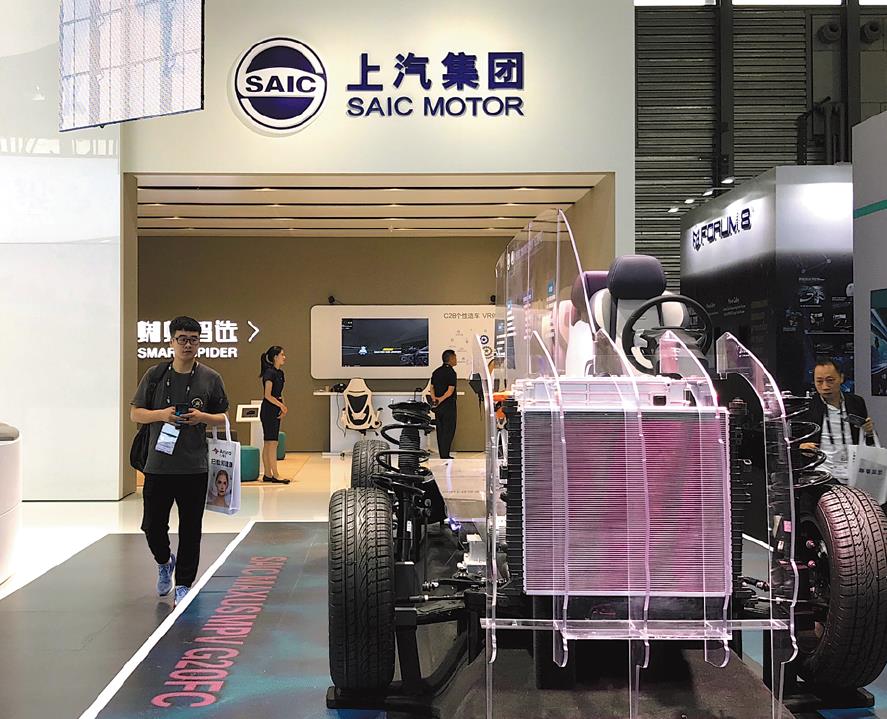
Two of China's State-owned carmakers, SAIC Motor and GAC Group, have joined hands to develop vehicle technologies and explore overseas markets as the country's vehicle market remains sluggish and new technologies demand bigger investment.
"The partnership will be helpful for the two companies to brace for transformations in the automotive industry," said SAIC, China's largest carmaker and partner of Germany's Volkswagen and US carmaker GM, in a filing to the Shanghai stock exchange last week.
According to the five-year deal signed on Dec 23, the two companies will co-invest in new technologies involving electrified vehicles, smart cars, connectivity and also co-develop vehicle platforms.
Both automakers offer competitive electric models in the market but neither has a large volume.
The new energy vehicle brand of GAC, a partner of Japan's Honda and Toyota, sold 38,600 vehicles in the first 11 months of the year, accounting for around 4 percent of the total in China.
Analysts said it is essential for carmakers to cooperate in the development of new technologies that demands a lot of money, especially when the new car market has not been satisfactory.
Volkswagen AG said earlier this year it will invest around 60 billion euros ($66.3 billion) in the next five years in digitization as well as producing more electric and hybrid vehicles.
Chen Qingtai, president of think tank China EV100, said, "Developing modularized platforms can slash costs and carmakers in China should partner with one another, no matter it is Chinese companies or international ones."
He said many former rivals have become partners, including Volkswagen and Ford, so it will be challenging if a company insists on doing all things alone.
"If their cooperation is successful, there will be millions of vehicles built on the same platform, and how can any single company compete with them (and win)?" Chen said.
SAIC and GAC are also planning to explore cooperation in overseas markets covering their sales networks, international logistics resources and manufacturing facilities.
This would give them a helping hand as the Chinese market has seen slumping sales for almost two years and analysts say there is no sign of a fast recovery.
SAIC sold 5.54 million vehicles from January to November, a 13.3 percent fall year-on-year. GAC delivered 1.87 million automobiles in the same period, down 4.34 percent year-on-year.
China's new vehicle market began sliding in the second half of 2017 and the China Association of Automobile Manufacturers expects the downward trend to continue well into 2020.
The association estimated that sales in 2020 would fall 2 percent to around 25 million, compounding to an estimated 8 percent fall in 2019.
Both carmakers have explored overseas markets. GAC operates in 16 countries, mostly in Southeast Asia and the Middle East.
SAIC has also built a manufacturing facility in Indonesia, where growth is fast despite the small volume. It purchased a plant from GM when the US carmaker left India and now makes the Hector SUV under its MG brand.
While car sales in India are stuttering, the market is expected to become the world's third-biggest by 2026, behind China and the United States, according to LMC.
"It's an opportune time for China's automakers to enter India. There is currently a gap in competition and it may take a couple of years for some of the established carmakers to bring new products to the market," said consultancy LMC analyst Ammar Master in an interview with Reuters.
Analysts said if carmakers can integrate their respective advantages overseas, they have a better chance of succeeding in international markets.
The SAIC-GAC partnership is not the first among Chinese carmakers. Last year the country's largest SUV producer, Great Wall Motors, and State-owned BAIC Group joined hands in vehicle platforms, power trains and new technologies.
As long as such deals are beneficial for all parties, "we'd like to explore two-party or even multiple-party cooperation, be it sharing vehicle platforms or production capacity," said Wei Jianjun, chairman of the carmaker, after the deal was signed.
Also last year, Changan Automobile set up a joint venture with FAW Group Corp and Dongfeng Motor Corp to establish a ride-sharing platform to get a slice of China's growing mobility market, currently dominated by Didi Chuxing.
The new venture, called T3 Mobile Travel Services, said it would introduce partners from other industries to build the service and make use of the development of driverless cars to offer safer and more efficient travel services.
The move came after the three companies signed an agreement of strategic cooperation in December 2017.











