



China's foreign exchange reserves rise









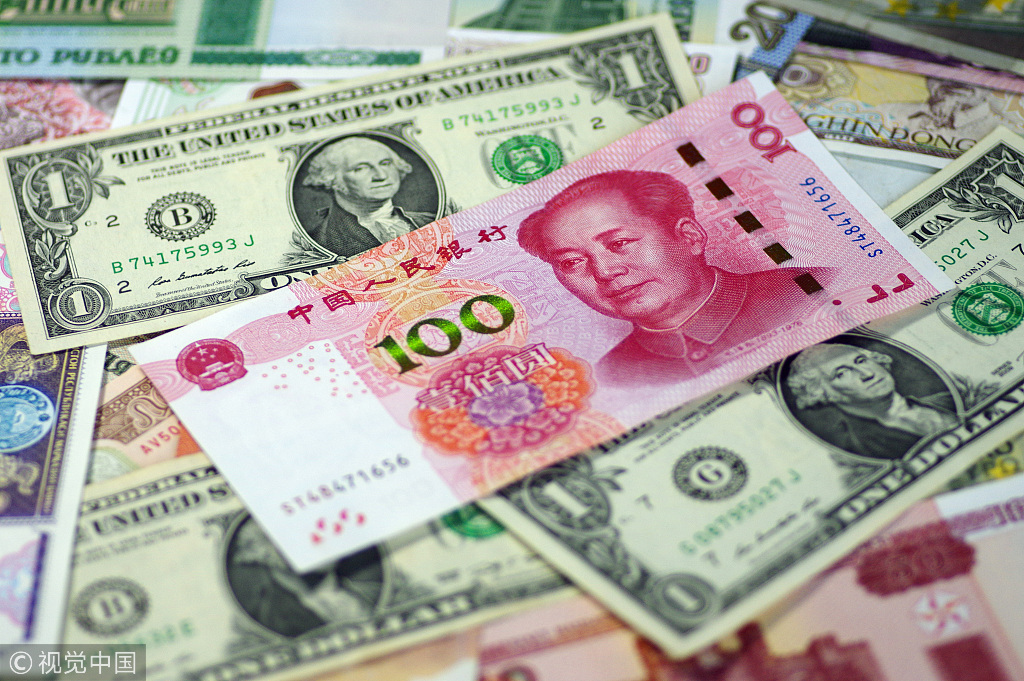
China's foreign exchange reserves rose to a six-month high of nearly $3.11 trillion as of the end of December, supported by stronger exports and stable capital inflows amid the financial opening-up, according to regulators on Tuesday.
Reserves increased by 1.1 percent over 2018 and were up by $12.3 billion in a single month in December, suggesting general equilibrium of supply and demand in the foreign exchange market, the State Administration of Foreign Exchange said. Reserves decreased by $88.7 billion in 2018.
The weaker US dollar index influenced by the easing monetary policy in large economies, and price drops of major countries' bonds, have changed the value of foreign assets reserved by the Chinese government, a statement on the SAFE website said.
Optimism remains
Although global political and economic uncertainties are rising, Chinese monetary authority remained optimistic about stable foreign exchange reserves in the future, supported by economic growth within a reasonable range, SAFE spokeswo-man Wang Chun-ying said on Tuesday.
Foreign exchange reserves usually refer to assets denominated in foreign currency, including cash, foreign bank deposits and foreign securities. The reserves can be used to stabilize the exchange rate and repay foreign debts.
The US dollar index dropped by 1.9 percent last month to 96.4, while the Chinese yuan appreciated to about 6.97 yuan per dollar at the end of December, adding to nearly 1 percent in November. Recent research by Morgan Stanley predicted that the onshore yuan will appreciate modestly against the US greenback in its trade-weighted basket in 2020, given a better economic growth outlook.
"RMB fluctuations have become more market-driven in recent years, serving as an automatic stabilizer to changes in domestic and external conditions," the research said. The Chinese government is expected to continue to open up the domestic capital market. As a result, robust capital inflows are expected to be seen this year, which can maintain stable foreign exchange reserves and support a stronger yuan.
Wen Bin, chief economist at Minsheng Bank, said the stronger exports in December, showed by some leading economic indicators such as the purchasing managers' index, has contributed to the rise of foreign exchange reserves, because of the easing trade tensions between China and the United States.
In 2019, the central bank increased its holdings of gold by 2.7 million ounces, to 62.64 million ounces by the end of December, a level that was unchanged from October.
The price of gold almost hit the six-year high-test level to $1,600 per ounce, up by about 2.4 percent this week, because of elevated geopolitical risks across the heart of the Middle East. Global investors are likely to reserve more gold to hedge fluctuations in the capital market as they speculate that Iran will deliver on threats to retaliate against the United States for the killing of a senior general, analysts said.
Even the Chinese central bank may increase purchases of gold in 2020 if the geopolitical risks continue to rise, but the amount will not be too large, said Zhao Qingming, chief economist at the Institute for Financial Derivatives under the China Financial Futures Exchange.
Key tasks
Pan Gongsheng, vice-governor of the PBOC and the director of SAFE, said key tasks in 2020 include promoting the diversification of foreign exchange reserve investment and supporting the Belt and Road Initiative. He added that the safety and liquidity of reserve assets should be ensured, while preserving and increasing their value, according to a statement.
As China's financial opening-up will continue, more foreign investors will participate in domestic markets. The reform of foreign exchange management is expected to be promoted steadily this year, after major progress in interest rate liberalization reform, said Guan Qingyou, dean and chief economist at the Rushi Financial Research Institute.




















