From Hanoi to hutong, pho is the way to go









On July 1, 2003, a day after Beijinger Cong Peizhi landed in Sydney, his friend took him to a Vietnamese pho restaurant on a cold winter's day in the Southern Hemisphere.
That bowl of pho impressed him so much that, when he moved back to China five years ago, he decided to open a pho restaurant in his hometown-after spending a year in Ho Chi Minh City, learning how to make popular Vietnamese noodle dish.
"Now when I look back, the first pho I tried in Sydney perhaps wasn't the best in terms of flavor, but the taste of the soup certainly stuck in my memory for a long time after," Cong says. "Pho has a clear soup base, unlike the thick hotpot or stewed soups in Chinese cuisine, but its complexity and multiple layers of flavor are really surprising."
Cong set up his pho restaurant, Wan, three years ago with several other partners in a hutong (alleyway) in Beijing's Wudaoying, near the Yonghegong Lama Temple.
Before it opened, Cong visited Vietnam seven times in the space of a year to figure out how to make the soup base. "I noticed that every pho restaurant in Vietnam has its own recipe for the soup base, and there is no right or wrong way-just different flavors."
Cong rented an apartment in Ho Chi Minh City, and almost every day he would cook at least one pot of soup and invite his local chef friends to taste it and offer advice.
"The process of finalizing the recipe for my soup was a long yet interesting one. It was like performing a chemistry experiment. I changed the amount or the order of each ingredient or spice added to the soup and recorded the results," Cong says.
Since the restaurant opened, Cong has continued to adjust his soup-h(huán)is current version uses dozens of spices. He uses basil and mint from Vietnam to ensure the flavor is authentic.
Every day, his chefs boil a large pot of soup for six hours with around 15 kilograms of beef and bones with roast onion, ginger and fried spices.
The next matter to sort out was the rice noodles, and Cong experimented with many kinds before settling on specific fresh variety.
"Dried noodles will suck in the flavor of the soup, so if you serve the pho with them, the soup will be less flavorful after five minutes, but fresh rice noodles never affect the taste," Cong explains.
The decor of Wan is a natural space filled with vitality, thanks to the surrounding plants and flowers. It fits the atmosphere of the old Beijing alley, and the humidity of the environment reminds diners of Vietnam.
"At first, the designers we invited all gave us a plan for decorating the restaurant in the Vietnamese style, but it didn't really match with the feel of the hutong," Cong says. "Our final choice of decoration combines nature with modern art."
According to Cong, the flowers in Wan change according to the season, and the plants from both the north and south of China grow well in the courtyard. They often host small art exhibitions at Wan.
Last summer, they hung dozens of white umbrellas upside down over the courtyard, making the restaurant an online "checkpoint" for young people following the latest trends.
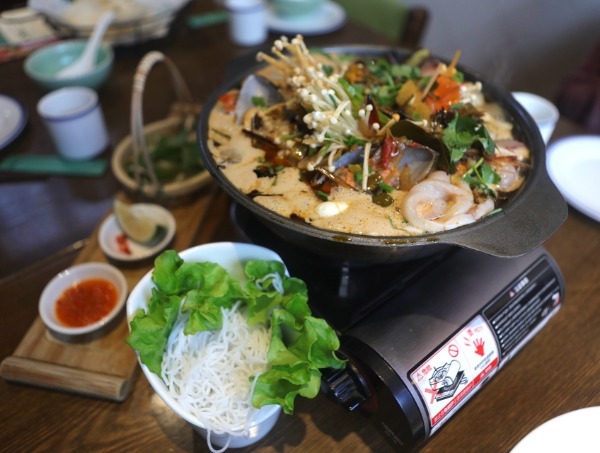
For his winter menu, Cong has launched a beef-soup hotpot and a Tom Yum Kung soup hotpot. The two soup bases are similar to the one used in the summer pho but are boiled for an extra hour. Cong has adapted the soup base to ensure the soup won't be too thin by the end of the meal.
"Hotpot is the Chinese way of enjoying hot soup, and I just hope that whether they try my hotpot or just a bowl of pho, my diners will enjoy the dish as much as I did 17 years ago."