Nation still has sufficient policy tools









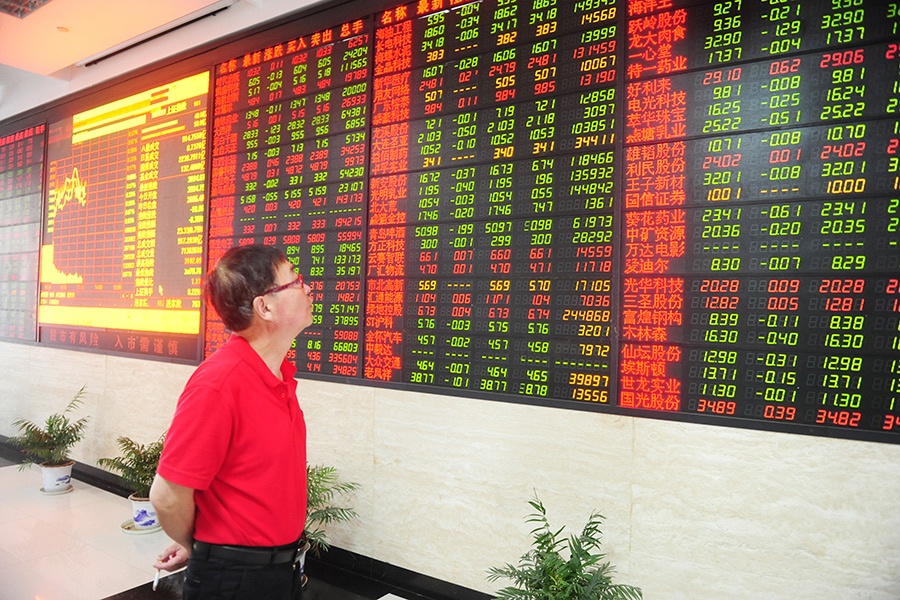
China still has relatively ample policy tools to maintain the stability of its financial markets and the yuan's exchange rate despite emerging markets' stocks and currencies facing growing selling pressure amid the novel coronavirus outbreak, economists said on Monday.
The country's A-share market and its currency will not be immune to the external volatility but China could be better positioned than other countries to weather the global financial turmoil as policymakers in Beijing have enough ammunition to maintain domestic market stability, they said.
"While it is impossible for the A shares to stay completely unaffected, the epidemic in China has been better controlled and the economic outlook is becoming clearer. Additionally, the Chinese central bank is capable of keeping domestic liquidity and the market stable while there have been some capital outflows," said Xu Gao, chief economist at BOC International.
The benchmark Shanghai Composite Index was down by 3.1 percent on Monday at 2660.17 points. The ChiNext Index in Shenzhen, which tracks technology-focused startups, declined by 4.59 percent to close at 1827.05 points. The value of onshore-traded yuan weakened to 7.12 per dollar as of Monday afternoon.
The stock market rout in the United States over the past weeks has caused a domino effect in other parts of the world, prompting investors to sell their risky assets and driving up the demand for the US dollar in cash. This trend has put increasing downward pressure on emerging markets' stock prices and currencies and there have been signs that capital begins to flow back to the US.
The A-share market has seen a net foreign capital outflow of more than 20 billion yuan ($285 million) since the beginning of the year, according to the China Securities Regulatory Commission.
Nonetheless, the country's equities markets have remained relatively stable and shown stronger resilience against external fluctuations. The Shanghai Composite Index has declined by about 10 percent since February while the US Dow Jones Industrial Average Index has plunged by more than 30 percent.
Li Chao, vice-chairman of the China Securities Regulatory Commission, said on Sunday that the resilience of the A-share market is related to the earlier domestic reform, which effectively reduced the amount of highly leveraged investment in the market.
The relative stability of the Chinese equities market also benefited from the sufficient liquidity and the low valuations of listed companies. Investors' sentiment is also supported by an improving economic environment as 98 percent of listed companies have resumed production, Li said.
While policymakers in Europe and the United States appeared to have run out of policy options by already substantially cutting interest rates to near-zero or negative territory to stimulate the economy, China's central bank and financial authorities have been more conservative and refrained from using massive easing policies to flood the markets with cheaper money.
The People's Bank of China, the central bank, has kept the benchmark one-year lending interest rate unchanged at 4.05 percent from February's level. Instead, what the PBOC has done is cutting banks' reserve requirement ratios in a targeted approach and offering more relending to commercial banks. These moves aimed to ensure smaller businesses are able to gain necessary and affordable credit and prevent their cash flows from being disrupted by the economic damage caused by the epidemic.
"Reserving policy room appears to be a wise move at the moment for the central banks as we believe that there could be a substantial economic recession when global monetary and fiscal policies are completely depleted," said Steven Zhang, chief economist at Morgan Stanley Huaxin Securities.