Fragrant memories










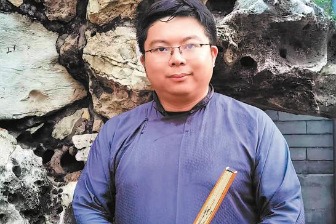
Ho's efforts drew the attention of then-acting Kwun Tong district commander Alice Lee Nga-lai (Tseung Kwan O was under the Kwun Tong District police division). She invited Ho to hold lectures, introducing her knowledge of the incense trees and their special values.
Lee learned through Ho's guidance that all species of Aquilaria produce a dark aromatic resin. The resin protects a wounded tree from fungal infection. Sections of tree trunks or branches that contain patches of fragrant, resinous wood enter into the trade under the name "agarwood". Also, the resin accumulated from the wood is used as a substitute for a valuable Chinese medicine called "Chen Xiang", which once derived primarily from the species Aquilaria malaccensis and imported from the Asian tropics.
Deep gashes were often found at the base of trees by poachers, Ho mentioned, as a test to see if the tree is worth felling. "They will come back in a month to check if resin appears. If it does, they will just chop the tree down and carry it across the border," she said.
Ho's solution was to remove the resin appearing on the surface and apply a wound dressing onto the new gash to prevent the tree from producing resin. "It is like a race," she said. "Poachers don't want the tree to die immediately otherwise there will be no resin so both the poachers and I pray to be the first to find resin and take it away."
Yet Ho's efforts are not always successful. Some poachers take away the entire tree root, leaving Ho with no chance. Roots are used to make root carvings, which could be sold for hundreds of thousands of dollars. When it comes to protecting trees, barriers work best.
The effects are obvious. Enhanced protection at the governmental level has led to a sharp drop in the total weight of trees felled.
From 2011 to 2019, nearly 1,000 kilograms of wood were known to have been poached, according to police statistics.
The Hong Kong Customs and Excise Department detected eight cases of agarwood smuggling from the city to the Chinese mainland between 2011 and 2015. A total of 800 kilograms of agarwood were seized. From 2015 to 2019, only 22 kilograms of agarwood were intercepted by customs officers.



- Dazzling Guangzhou lantern display begins countdown to Spring Festival
- Huizhou takes major step forward as petrochemical hotspot
- Beijing's Shunyi district cracks down on crimes related to public welfare
- Hunan's smoked fish and meat arrive in time for Spring Festival
- International arrivals to Guizhou skyrocket after visa-free policies
- Hubei deputy proposes museum of ancient Chinese law at Qin bamboo slip site