China's Chang'e-4 probe survives 500 Earth days on Moon's far side









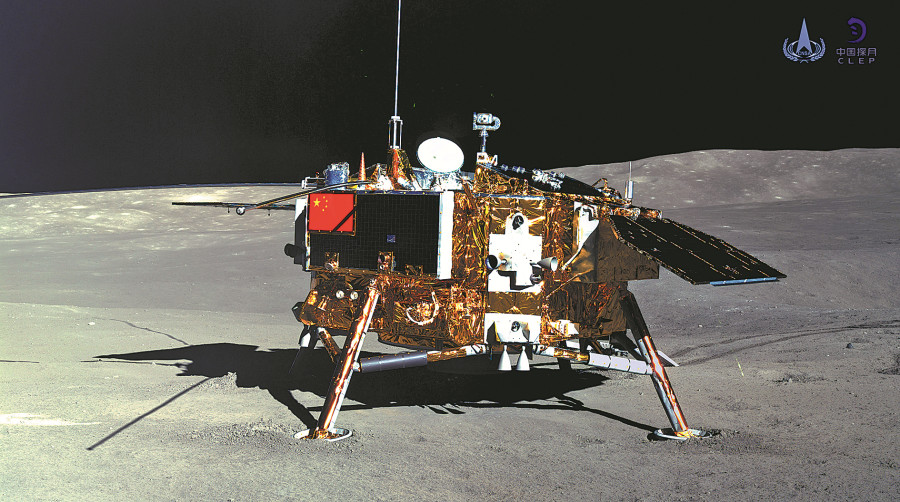
BEIJING - China's Chang'e-4 probe has survived 500 Earth days on the far side of the moon while conducting a scientific exploration of the virgin territory.
The lander and rover of the Chang'e-4 probe have resumed work for the 18th lunar day on the far side of the moon after "sleeping" during the extremely cold night.
The lander woke up at 3:25 am Sunday (Beijing time), and the rover awoke at 11:53 am Saturday. Both are in normal working order, according to the Lunar Exploration and Space Program Center of the China National Space Administration (CNSA).
The Chang'e-4 probe, launched on Dec 8, 2018, made the first-ever soft landing on the Von Karman Crater in the South Pole-Aitken Basin on the far side of the moon on Jan 3, 2019.
A lunar day equals 14 days on Earth, and a lunar night is the same length. The Chang'e-4 probe switches to dormant mode during the lunar night due to the lack of solar power.
The rover Yutu-2, or Jade Rabbit-2, has driven 447.68 meters, and is now 292 meters away from the lander. It has conducted scientific detection on lunar rocks, the lunar soil on its track and some impact craters.
Scientists used the Lunar Penetrating Radar on Yutu-2 to study the geological structure with a depth of 40 meters, unveiling the secrets buried under the surface of the far side of the moon, enriching our understanding about the history of celestial collisions and volcanic activities and shedding new light on the geological evolution on the moon.
Scientists also analyzed the data of the infrared imaging spectrometer on Yutu-2 and revealed the material composition on the moon's far side, verifying that the lunar mantle is rich in olivine, which deepens our understanding of the formation and evolution of the moon.
China plans to launch its first Mars exploration mission Tianwen-1 in July. Due to the modification of the ground communication facilities, the rover and the lander will conduct in-situ detection during the 18th lunar day, said the CNSA.
The scientific tasks of the Chang'e-4 mission include conducting low-frequency radio astronomical observation, surveying the terrain and landforms, detecting the mineral composition and shallow lunar surface structure and measuring neutron radiation and neutral atoms.
The Chang'e-4 mission embodies China's hope to combine wisdom in space exploration with four payloads developed by the Netherlands, Germany, Sweden and Saudi Arabia.


- Chongqing hosts western China's largest water lantern festival
- Guizhou University, Sri Lankan counterpart explore joint research center for medicinal plants
- Tianjin Port's autonomous tugboat completes live berthing test
- Foreign investors invited to join Shanghai's modern industrial system
- Mainland digital works draw young visitors at Taipei book fair
- China-Laos 500-kV power interconnection project achieves full line connectivity