


Paintings to scale a treasured traditional art form










Anglers are likely to recount "big fish" stories about herculean battles with silver-scaled kraken. These usually end with the declaration, "It was definitely at least this big!", as they exaggeratedly gesticulate with their hands to indicate the vastly overstated length of their former aquatic nemesis.
It was probably much easier to persuade people that these tales were true before the age of camera-laden smartphones.
However, even before the invention of photography itself, avid anglers around the world came up with inventive ways to prove the legitimacy of, and record, the outstanding fish they managed to land. While those in the West opted for things like fish taxidermy, in China a different method was used to, literally, mark an impressive catch-one that has since evolved into a traditional art form.
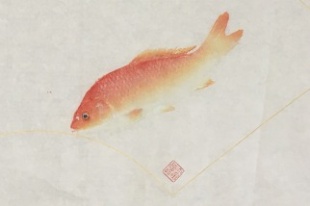
The method is called yuta, or fish printing. People apply paint to the fish and press it on paper to record its exact shape and size, and such details as the texture of its scales, fins and tail.
Yu Qinyuan, a native of Gaomi, a county-level city of Weifang, Shandong province, has been a leading figure in inheriting, practicing and promoting the art form.
The 56-year-old was first exposed to the practice as a child.
"I grew up with my grandparents, a scholarly family, who knew the basic fish-printing techniques. When they caught a big fish, they'd print it and frame it as a memento," he recalls.
Yu has been practicing fish printing full time for 10 years. During that time, he has learned from masters from around the country and developed his own systematic approach to the art form.
The uniqueness of fish printing, Yu says, lies in that it is able to precisely capture the details of the fish species. "Each fish scale has its distinctive texture, like a person's fingerprint. The texture cannot be drawn by even the most perceptive painter but is clearly visible when rubbed onto the paper."
He says that a fundamental rule of fish printing is to not use a pen or brush to add any details to the fish. The only exception to the rule is the eyes, which require a great painting technique and often take longer than the printing process.