Globalism also entails Chinese culture









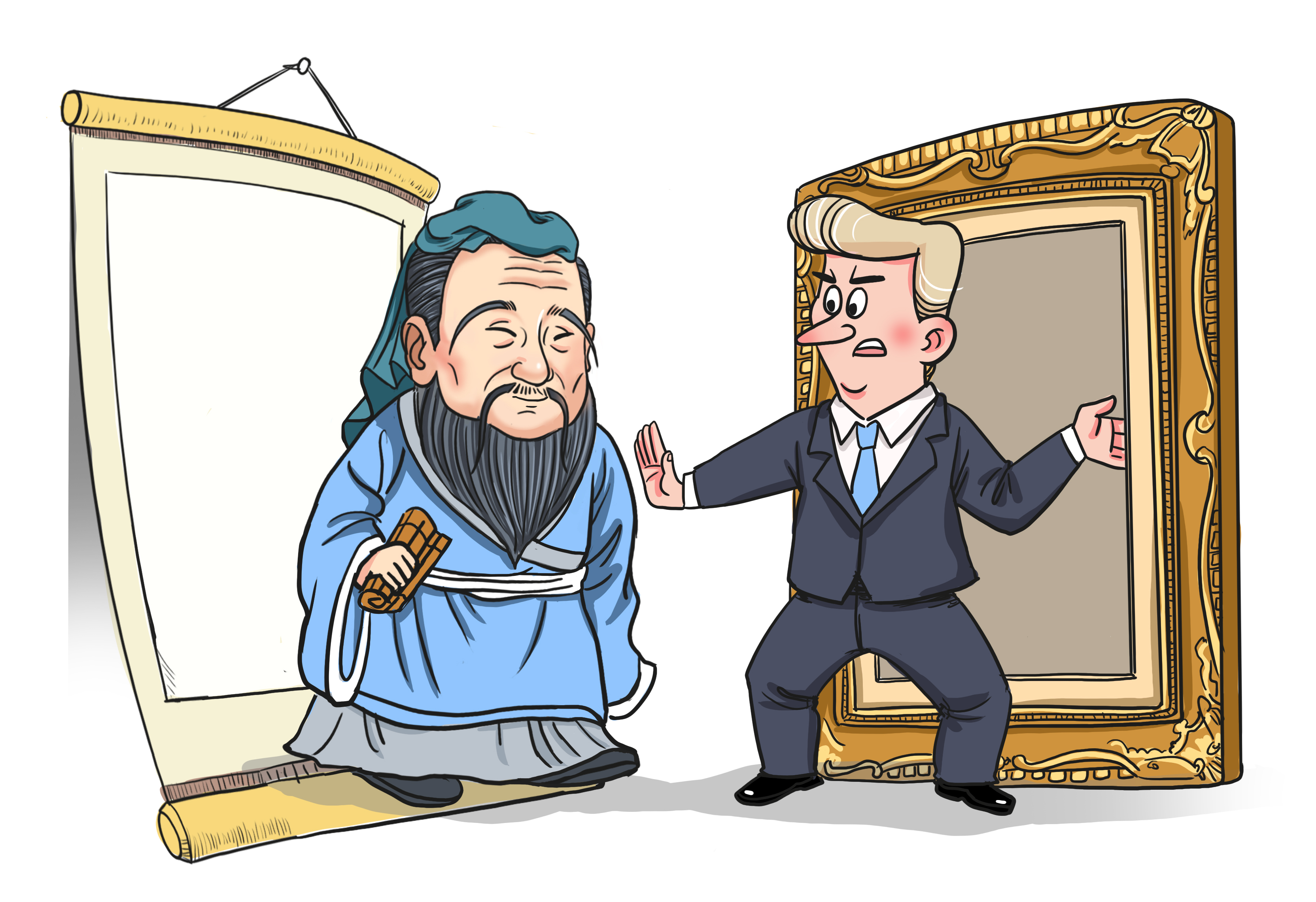
For years, the Confucius Institutes have been an eyesore to some US politicians, and Beijing knows it. One such politician, US Secretary of State Mike Pompeo, recently said he hoped to shut down all Confucius Institutes on US university campuses by the end of the year. Before that, on Aug 13, he had condemned the institutes as "foreign mission of China".
In the spring of 2013, I visited Hanban to meet two of its officials-surnamed Yang and Ma. Hanban, or the Office of Chinese Language Council International, affiliated with the Ministry of Education, is a 20-minute taxi ride from Peking University. We had pu-erh tea while discussing some important issues. Yang and Ma both had read the essay on "How to translate Chinese key terminologies", in which I identified Chinese "untranslatables "such as shengren and wenming, and the Chinese word for dragon, long.
Why not promote these terms to the West?
Ma Jianfei, Hanban's director general, took it upon himself to research the realm of incorrect Western translations. At that stage, I had no idea about how political "culture" could get.
The Confucius Institutes, founded in 2004 and overseen by Hanban, were meant to be a post-modern answer to Germany's Goethe-Institut, founded in 1951, France's Alliance Fran?aise, founded in 1883, and the United Kingdom's British Council, founded in 1934-all of which were accused at some point during their ascent of protecting their nation's strategic, political and economic interests abroad.
The United States for example digests a lot of French and German propaganda about European Union socialism, free schools, free healthcare and high taxes. But such subversion is only tolerated because France and Germany do not pose any threat to US' global hegemony. With China, it is another story, however.
How do you promote the language and culture of 1.4 billion Chinese people (plus 40 million overseas diaspora) in a Western nation state whose government is partly run by white supremacists and racist officials? I mean, every student in China learns American English and studies Western culture-what's the big deal?
It was always going to be an uphill task. That's why Hanban's vision is: more transparency, cultural exchanges and academic cooperation.
Not all Western officials have intercultural competence. Some Western ideologues resent China and believe that Chinese professionals do not belong in their country, as the recent attacks on Chinese media outlets such as China Central Television and People's Daily, and Chinese companies such as Huawei, Tencent and ByteDance exemplify.
The Confucius Institutes are apolitical and represent Confucian reciprocity. The West brought Western values to China, and concepts such as democracy, human rights, rule of law, economics, capitalism and communism. That was true soft power. China, on the other hand, has some to give in return. The Confucius Institutes teach Putonghua (Mandarin), so all those students can learn the corresponding Chinese words for those concepts. They will learn how to write democracy in Chinese-minzhu zhuyi.
But despite the goodwill, the Confucius Institutes still face severe criticism from Western (state-employed) academicians who should know better about globalism. They are not happy that Hanban is affiliated with the Chinese Ministry of Education. Also, some of them consider the name "Confucius" to be intrusive. Picture a fictional Washington-funded global "Jesus Christ Institutes" project.
What to do? China must drown the West in Chinese names, brands and trademarks, not merely teach a foreign language but a global partner language. Most people learned English because they had no choice. Every new name, brand and trademark seemed to be in English and to come out of the US.Markets and education all followed that trend.
Just ride out the new global diversity trend of Chinese names, brands and trademarks, and more Westerners will be drawn to Chinese culture.
Besides, the numbers of students passing out of the Confucius Institutes over the past 16 years have been largely exaggerated by some Western politicians. Just a couple of hundred classrooms of their own, yet by the ministry's own data, there may be about 100 million Chinese language learners in the world. So where do those millions of students study the Chinese language?
The answer is: in local organizations and through market-driven initiatives. In fact, the Confucius Institutes spurn foreign universities and entrepreneurs to invest more in their own China studies, language schools and research centers.
Holding cultural China's ground against anti-globalism forces in the US is vital. The world is watching. The only way to promote diversity and globalism, I think, is defining the Chinese terms. It may taunt Washington that Confucius taught lofty pragmatism:"Settle one difficulty, and you keep a hundred away." If the white men in the West are not willing to share the world with others, it will go to pieces.
The writer is a German cultural critic, author of The East-West Dichotomy, and commentator on Sino-Western affairs.