



Latin America gearing up for green commute









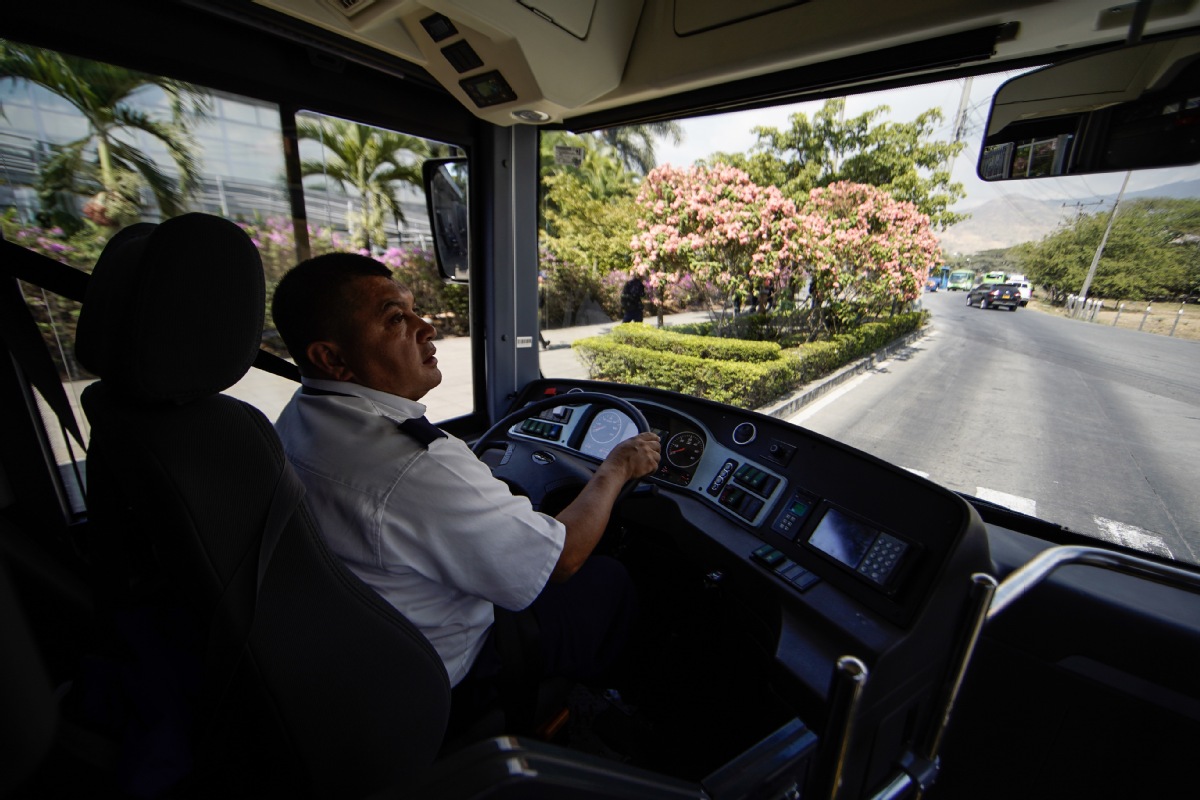
Megacities adopt fleets of electric buses manufactured by Chinese companies
Latin American megacities are looking forward to pollutant-free public transport thanks to growing supplies of Chinese electric buses.
Both Mexico City and Bogota saw breakthroughs on their streets in September. The deployment of more than 480 BYD and Yutong electric buses from China in Bogota, the capital of Colombia, began in September, while Mexico City recently put new buses into operation. Santiago, the capital of Chile, also boosted its fleet.
"These deliveries will consolidate Colombia's leadership in electro mobility in Latin America," said Oliverio Garcia, president of ANDEMOS, the Latin American Association of Sustainable Mobility.
Buses have long been polluters of sprawling urban centers such as Mexico City, Sao Paulo and Buenos Aires. These, along with similar cities in countries including Chile, Peru and Colombia are rapidly pushing ahead with plans to transform public transport with environmentally clean fleets of electric buses made by Chinese companies.
"Electro-mobility has no reverse gear in the region," Garcia said.
In Mexico City, the first fully electric bus debuted on Sept 24 on Line 3 of the Metrobus. More units are scheduled within the year, according to Mexico News Daily.
"I have committed myself to the goal of Mexico City having a fleet of 500 trolley buses in 2023, five times bigger than the one that existed in 2018," said Claudia Sheinbaum, mayor of Mexico City, during the recent launch of newly arrived Yutong buses.
Yutong Bus is a familiar name in Central and South America. Based in Zhengzhou, Henan province, Yutong delivered 100 fully electric buses to Santiago in 2019.
The mayor is expecting the reduction of polluting emissions and greenhouse gases.
Metrobus Director Roberto Capuano announced that the operating cost is 30 percent less than that of a diesel-fueled bus, Mexico News Daily said. Also, the new buses promise a better experience for passengers and drivers, offering a smoother ride.
The biggest player in transport transformation so far is Chile, with over 400 public electric buses in the capital Santiago, which launched the region's first electric bus corridor in October 2019 and has recently added another 40 electric buses. Other Chilean cities, such as Las Condes, Valparaiso and La Reina, are also transforming the way their residents travel.
Chile is building what will be one of the largest bus charging stations in the world, said Andres Barentin, president of the Chilean Association of Electric Vehicles, or AVEC, referring to a terminal that can charge over 200 buses simultaneously.
The support of electricity providers in Chile has been key. More sectors in the region's most advanced market are supporting the transition to more sustainable electric mobility.
"Chile was a pioneer in Latin America," said Alvaro Flano, director and former president of AVEC. He is also a director of multiple companies involved in electric and sustainable mobility in Chile.
Advantage in the market
Medellin, Colombia's second-largest city, has a subway but electric buses are helping to integrate the various parts of the public transport system. The city bought the buses from BYD a year ago. BYD has emerged as the largest electric bus provider in Latin America, with buses operating in Chile, Brazil, Colombia, Ecuador, Argentina, Peru and Uruguay.
"Nowadays China has the advantage in the market and if it has the ability of managing it and of understanding the market's drivers, it could really expand the market," said Barentin from AVEC.
Over the years Chinese companies have been developing green technology and best-in-class products, helping the region achieve important milestones such as transforming public transportation.
Also eyeing the Colombian market is SAIC Motor subsidiary Shanghai Sunwin Bus Corp, which has supplied dozens of buses to the city of Cali. Another Chinese firm in the region is Xiamen King Long United Automotive Industry Co, which has sold 25 buses to Santiago and another 10 to Montevideo, capital of Uruguay.
For most electric bus makers, the region's most desirable market is Brazil, Latin America's biggest economy. Brazil's National Union of Motor Vehicle Components Industry said there are 390,968 buses operating in the country, but only 247 are electric.
Aware of the potential, BYD, the largest provider of electric buses in the region, is premiering a state-of-the-art manufacturing plant to support electric bus production for the domestic and international markets. Its latest investment, $2.7 million for a 5,000-square-meter facility in the city of Manaus, is its third plant in Brazil.
The writer is a freelance journalist for China Daily.










