



On the other side of the digital divide









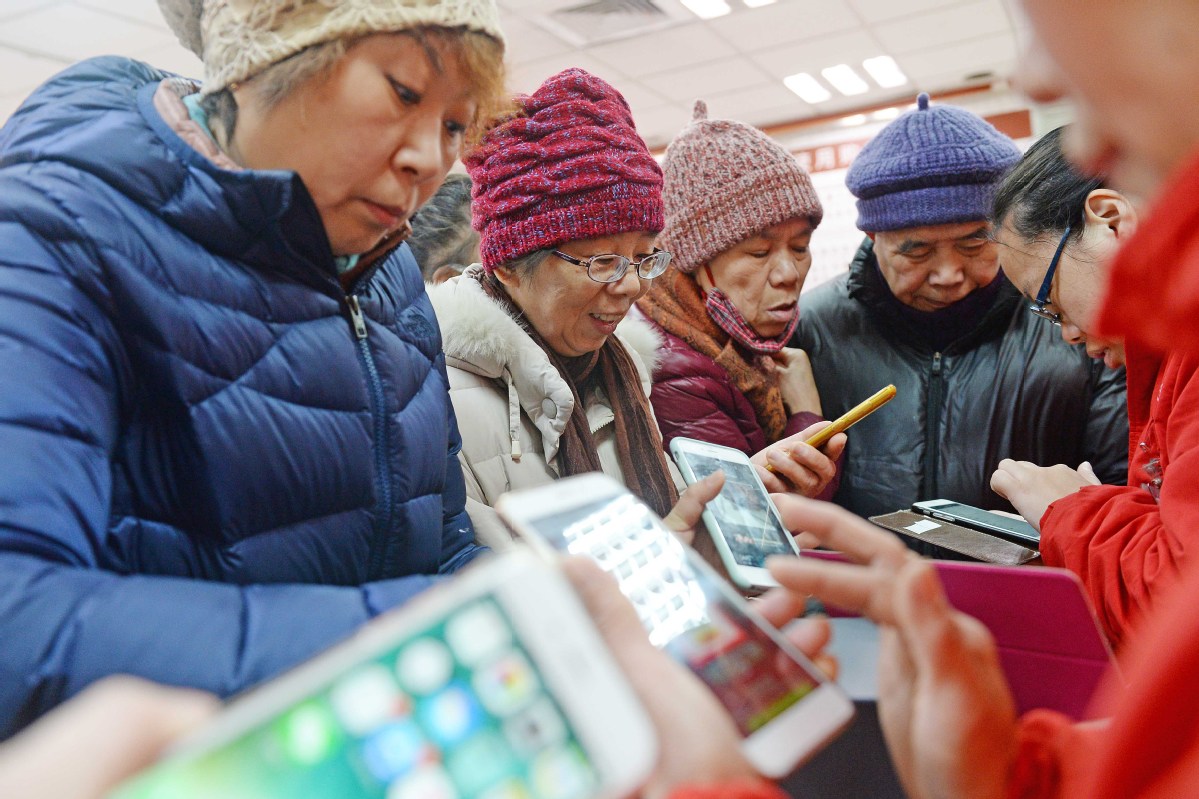
Lower threshold will help the elderly connect to information age, writes Li Lei.
Green, yellow, red. Traffic lights? Changing colors of foliage in the fall? Well, they signify something more.
As the monthslong lockdown to contain the novel coronavirus eased in Harbin, Heilongjiang province, Wen Caili, 60, ventured out of her home to get a taste of freedom.
But the retired kindergarten administrator, who lives with her daughter, son-and grandson-in-law in the northeastern city, soon found herself bound by new shackles.
"Health checkpoints" have come up across Harbin. And the personnel manning one such checkpoint demanded that Wen show her "health code"-a digital pass that comes in green, yellow or red.
Green allows people to travel almost unimpeded across the city. Yellow and red both bar visits to shopping malls, supermarkets and other public spaces, and limit the use of public transportation. Yellow requires a quarantine period of seven days and red, 14 days.
The health code is generated by a smartphone app based on the user's recent travel history and other data.
First adopted by authorities in Hangzhou, Zhejiang province, which hosts the headquarters of tech giant Alibaba, in February, the health code-based virus control measures have since been extended nationwide.
But despite being embraced by tech-savvy millennials, the code has confused people like Wen even as life across the country cautiously returns to normal.
Wen struggled to make sense of how her daughter, on her behalf, installed the app by submitting a host of her personal data.
And even with her smartphone in hand, Wen couldn't figure out how to scan the square-shaped Quick Response code-a mix of black and white pixels-to register at a health checkpoint.
The scanning registration process-usually required by restaurants and shopping malls-gives the digital footprint of the user which can be used to trace potential virus carriers in case of an outbreak.
According to a survey released last month by People Think Tank, which is affiliated to People's Daily, less than 1 percent of the nearly 6,000 respondents across the country said they did not have a health code, and more than 96 percent said the health code was required when visiting public places and offices in the cities or towns they live in.
Digital divide
Although she has been using a smartphone for six years, Wen's online reach has been limited largely to games, short videos and news disseminating apps.
For any cyber-based exploration requiring online payments or typing in home address-such as online shopping or using food delivery or car-hailing services-she seeks the help of family members.
"I cannot imagine living alone. I may not be able to even leave the neighborhood without my daughter's help," Wen said.
Wen completed high school in Hegang, a city about five hours' drive from Harbin. Which makes her better educated than many of her peers given that relatively few youths completed high school in the 1970s in China.
Wen is not alone from her generation to be confused with digital technology. A video clip widely shared online in late August showed a driver in Harbin refusing to start the bus full of passengers after a gray-haired man could not show his health code because he didn't own any electronic devices.
The driver called the police as the senior citizen refused to get down from the bus despite being told about the no-code-no-ride policy, with some young passengers appearing visibly irritated by the disruption.
The senior citizen was eventually driven to his destination by police.
The video drew a lot of criticism online, with many saying the policy discriminates against the digitally illiterate-the elderly and children. Others accused the irritated bus passengers of being cold-blooded.
The video also prompted the municipal authorities to consider reforms.
Netizens suggested the health data be attached to cards for senior citizens, which governments issue to people aged 60 or above. The magnetic card with the holder's real name is expected to help reduce senior citizens' reliance on electronic devices.
In fact, the Harbin municipal government and authorities in some other cities introduced health code substitutes in March.




















