


Piecing together the past
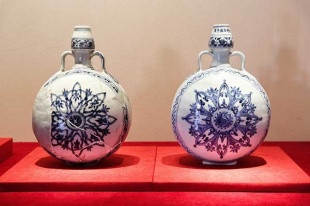
An exhibition at the Palace Museum showcases the high standards that the imperial kiln had to meet to satisfy the Ming emperors, Wang Kaihao reports.










"The Ming emperors often selected the supervisors of production in person," he says. "The best artisans and raw materials gathered in Jingdezhen, rigidly following guidance from the royal court. But the pieces in the museum cannot portray the complete splendor of the imperial porcelains because of the wear and tear they have experienced over the years."
Large-scale archaeological excavation has been conducted at the site of the imperial kiln since the 1980s to look for historical clues in the ruins, and metric tons of ceramic pieces have been unearthed according to Jiang Jianxin, honorary director of Jingdezhen Ceramic Archaeology Research Institute.
Since 2015, the Palace Museum has cooperated with Jingdezhen Ceramic Archaeology Research Institute to conduct comparative studies of the underground trove of ceramic fragments. Six exhibitions have been staged in the museum since then to review the evolution of the imperial kiln throughout different reigns.
"This final chapter of the series of exhibitions unveils the recent archaeological discoveries and displays a panorama of the achievements of the Ming imperial kiln," Lyu says.
Some of the new findings on display have corrected scholars' understanding of the history of some pieces, such as a fragment of a porcelain cup.
Four heavy blue-and-white cups in the collection of the Palace Museum with flared rims and deep rounded sides that are small enough to fit in the palm of a hand have marks on their bottoms indicating they were made during the reign of Emperor Yongle (1403-24)-who moved the capital from Nanjing to Beijing. But because their style differed from other pieces from that time, scholars were skeptical. However, in 2018, a broken piece of porcelain from a similar cup was found at the site of the imperial kiln in the stratum from the reign of Yongle, settling the matter once and for all.