


Getting ahead in the cloud
As the new semester began in September, students in the Third Wanquan Primary School in Lanping county, situated deep inside a valley in Southwest China's Yunnan province, had a special class.
About 50 grade-three students had their first online class on folk arts, taught by a teacher from a Beijing elementary school, thousands of kilometers away from the county.
After the bell rang, students sang a local song to greet their teacher in Beijing. "It never occurred to me that a teacher in Beijing could teach us," says He Shujie, a grade-three student.
The online class epitomizes the digitalization of educational infrastructure in China.
In 2019, there were 11.4 computers for every 100 students in Chinese primary schools, and 68.7 percent of these schools had internet access.
No child left behind
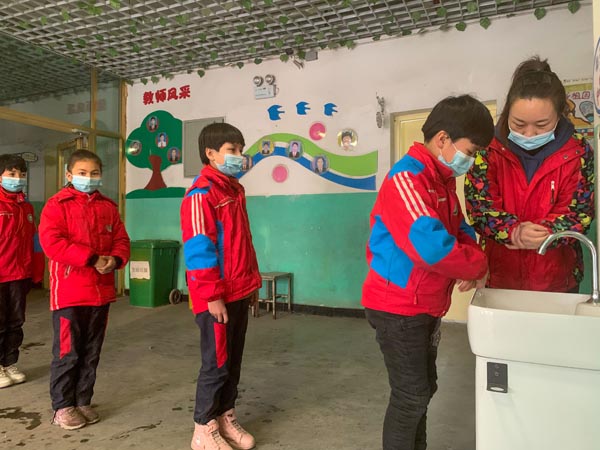
Ahead of classes every morning, Geng Qin, a teacher in Yukakbzichi Primary School, disinfects every corner of the classroom and prepares the masks that will be handed out to students.
The school, located in the city of Aksu, Northwest China's Xinjiang Uygur autonomous region, suspended classes during the COVID-19 epidemic.
Before the school reopened in September, teachers called every student to inquire about their health. The school also prepared sufficient pandemic prevention materials to ensure the safety of students after classes resumed.
"We will never let a child drop out of school because of the pandemic, and will do our best to ensure their safety during this challenging time," says Wang Le, headmaster of the school.
Outside influences
Extracurricular activities are encouraged at the Fanjia Primary School in the city of Guangyuan, Southwest China's Sichuan province.
Whether it is planting vegetables or visiting cultural relics, every Wednesday, teachers lead 55 pupils-most of whom are children left behind by parents who are migrant workers or from impoverished households-to learn something new outside the classroom.
On a plot of farmland in front of the school, several "automatic drip irrigation devices" created by pupils from plastic cans are being used.
Extracurricular activities, as an extension of classroom learning, can better shape pupils' personalities and improve their ability to analyze and solve problems, says Zhang Pingyuan, principal of the primary school.
In 2018, about 220,000 teachers, including about 40,000 specialized in music, sports, arts, science, and information technology, were added to the country's ranks of educators for the comprehensive development of students.








