


From virtual tours to relics' rescue









Protection of grotto temples
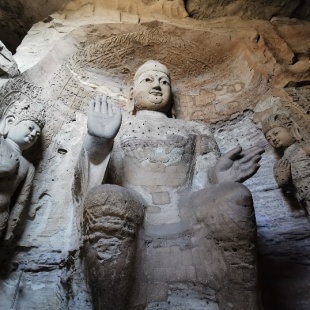
On May 11, Xi visited the 1,500-year-old Yungang Grottoes, a UNESCO World Heritage site in Datong, Shanxi province. There, he urged better displays of the cultural significance of the country's grotto temples to foster a stronger sense of cultural identity and enable further exchanges among civilizations.
The State Council, China's Cabinet, issued a set of guidelines in October to enhance protection and studies of such sites carved into mountains or rocks and visited by religious pilgrims throughout history.
The guidance also included a long-term plan to nurture expertise and technological breakthroughs in at-risk sites' restoration.
All administrations of the country's grotto temples are required to map their own plans for capping tourist numbers by the end of the year.

Early-stage civilization
Fruitful discoveries were made this year under a nationwide archaeological project called Archaeology China, which aims to explore the origins of Chinese civilization.
For example, China's earliest multigrid city layout was found in the 3,700-year-old Erlitou site in Luoyang, Henan province, which is widely believed to be the capital of the Xia Dynasty (c. 21st century-16th century BC)-the first dynasty recorded in Chinese history.
In Shuanghuaishu, a site in Henan's provincial capital, Zhengzhou, that dates back 5,300 years, archaeologists unearthed the highest-level residential complex of its time along the middle and lower reaches of the Yellow River, which is generally considered to be the cradle of Chinese civilization.
In Yuyao, Zhejiang province, the largest and oldest prehistoric shell mound in China was excavated at the Jingtoushan site, which dates back to 8,000 years ago.