Rice seeds carried to the moon and back sprout









Some of the 40 grams of rice seeds that made a round trip to the moon have sprouted and are ready for follow-up studies, according to Science Daily on Monday.
The rice seeds traveled to the moon and returned to Earth after 23 days of flight aboard China's Chang'e 5 lunar probe. This marks the first time China conducted a deep space induced mutation breeding experiment on rice.
The seeds were handed over to their provider, the National Engineering Research Center of Plant Space Breeding of South China Agricultural University, on Dec 23.
China was the first country to use space technology to induce mutation breeding of crops. "Mutations are the basis of species evolution, as well as the basis of breeding of new variety," said Guo Tao, deputy director of the space breeding center.
Rice is a model organism in genetic research. Using rice as a deep space payload to study the evolution of species helps to understand hereditary effects in deep space. It may also produce beneficial mutations that could be applied to rice seed selection and breeding and boost agricultural production, Guo added.
Guo said next they will conduct a series of selfing and outcrossing experiments on the seed to cultivate new rice varieties that satisfy future requirements in terms of resistance to diseases and pests, stress tolerance and adaptation to mechanized production.
To ensure national food security, China's total yield of rice needs to grow about 10 percent by 2030.
As a leading scientific research and innovation platform in space breeding, the National Engineering Research Center of Plant Space Breeding has conducted 24 space-induced mutation experiments on plants since 1996.
The experiment on the Chang'e 5 probe is different from previous ones. It was the first such experiment conducted in a deep space environment, the space flight time was longer and the probe encountered radiation in the Van Allen Belts and fromsunspot activity, said Guo.
Stronger hereditary effects are expected to be produced in this experiment, as a deep space environment is more similar to a real space extreme environment. It will help researchers learn how hereditary effects induced in deep space and a low-Earth orbit environment differ, and provide important experiment samples and data for further research on mutation rules in space breeding, he said.


- HK continues safety checks on buildings under maintenance
- China's Kuaizhou-1A rocket launches two new satellites into space
- Exclusive with Premio Paganini winner Zhang Aozhe
- Panda ambassadors fostering China-France friendship
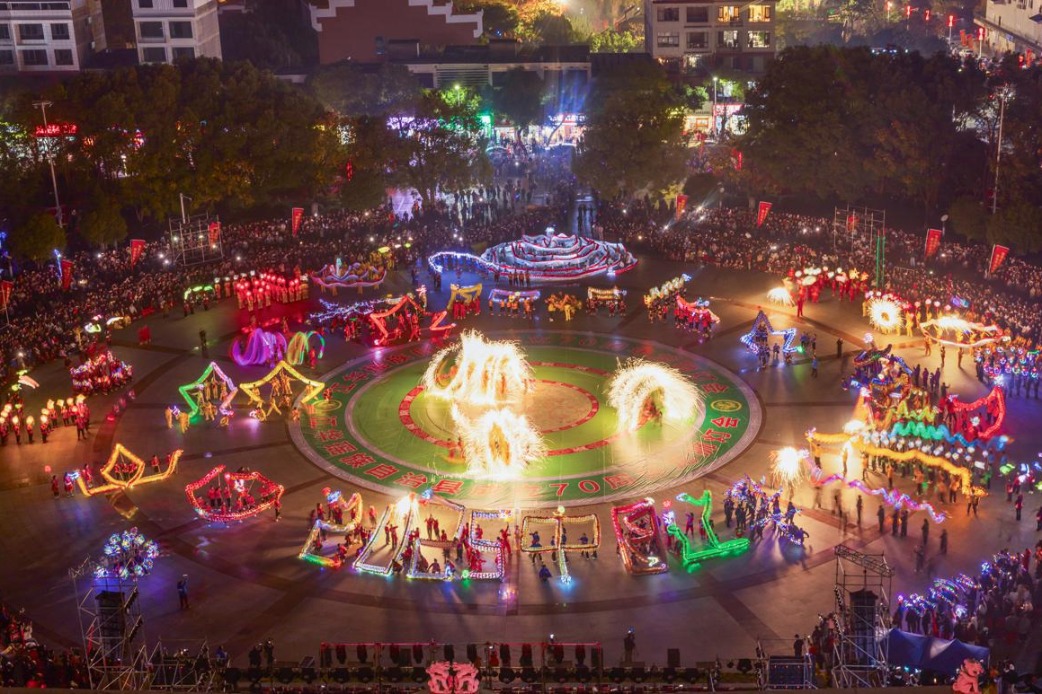
- Dragon-lion festival highlights tradition, unity in Jianghua
- China set to host World Conference of Science Journalists in 2029