Domestic prototype HTS train takes first public bow









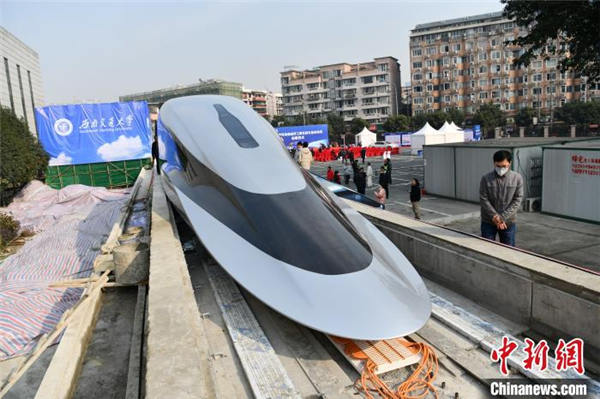
A prototype locomotive using high-temperature superconducting, or HTS, maglev technology was rolled out on Jan 13 in Chengdu, Southwest China's Sichuan province.
The domestically developed maglev train boasts a quoted speed of 620 kilometers per hour, according to Southwest Jiaotong University, one of the institutes involved in the train's design.
A 165-meter line to test the new train was also unveiled on the same day.
At the launch ceremony, the 21-meter-long silver-and-black locomotive was seen floating slowly along the track. Experts hailed the key development of HTS technology emerging from lab tests in China.
"Although the theory sounds good, everyone saw it (HTS maglev technology) as a lab toy in the past, without tests in a real situation," says Deng Zigang, deputy director of the university's research center for super-high-speed maglev transport in low-pressure tubes.
China has been a world leader in the construction of high-speed railways. By the end of 2020, the country had 37,900 kilometers of high-speed rail lines in service, the longest in the world, according to China's railway operator.
Maglev trains, levitated from the tracks and propelled by powerful magnets to avoid wheel-rail friction, are designed to break the speed bottlenecks facing high-speed trains. The country's first commercial maglev system was put into operation in 2003 in Shanghai. The 30 km stretch between downtown Shanghai and the city's Pudong airport is based on German "electromagnetic suspension", or EMS, maglev technology.
China's first medium-and-low speed maglev line fully supported by the country's own EMS technology started operating in May 2016 in Changsha, Hunan province. It has a quoted top speed of 100 km/h.
Involving an investment of 60 million yuan ($9.3 million), the HTS maglev project was jointly developed by Southwest Jiaotong University, China Railway Group and CRRC Corp.
Compared with other maglev technologies, HTS tech is more suitable for the futuristic concept of superfast transportation in vacuum tubes, where trains could, theoretically, hit speeds of more than 1,000 km/h, according to experts.
"The HTS technology can make the train float without electricity, and it can be moved with just one hand," says Deng.
At the site, a reporter succeeded in moving the 12-ton levitated locomotive with one finger.
Wu Zili, a senior engineer with the Southwest Jiaotong University, says the cost of the HTS maglev system is estimated to be slightly higher than high-speed rail, but is expected to fall if the mass production of its main components is achieved.