Benefits to be spread across more industries and regions









China has made notable progress in facilitating foreign investment through a raft of measures introduced in the past four years. These efforts mainly center on expanding market access, shortening the negative list for foreign investment and increasing the number of areas where the country encourages foreign investment.
They have effectively tackled the country's weak areas in the business environment and improved overall competitiveness in attracting overseas investment.
Steps worth noting include the consecutive revision of negative lists for foreign investors from 2017 to last year at both the national level and for free trade zones.
Foreign shareholding restrictions for commercial vehicle manufacturing and in the financial industry have also been removed and an increasing number of FTZs have been encouraged to undertake pilot programs to attract foreign investment.
Efforts to facilitate foreign investment started as early as 2004, when government regulations gradually changed the procedure for such investment from a registration process to project filing. By doing so, the procedure to apply for foreign-invested projects was reduced and the review process simplified.
Our research shows that from 2015 to 2019, the average value of foreign investment came in at $3.71 million.
Under the guidelines recently released by the National Development and Reform Commission, projects valued between $30 million and $300 million are likely to cluster in retail, manufacturing, scientific research, technological services, computing services and software. Some of these industries are included in the Catalogue for the Guidance of Foreign Investment Industries
With the newly issued facilitating procedures, overseas investors will find it more convenient to invest in such areas, and the volume of investments is likely to grow.
Our research shows that from an industry-based perspective, from 2017 to 2019 the retail and manufacturing sectors lead the way in attracting overseas investment, with the accumulated number of firms investing in these two areas exceeding 10,000.
China's Ministry of Commerce has also revised the Catalogue for the Guidance of Foreign Investment Industries, with 127 industries added. The revised catalogue, which took effect in January, is conducive to leveraging the positive role of foreign investment in stabilizing supply and production chains.
While manufacturing remains the mainstay of attracting overseas investment, the new catalogue encourages more overseas investment to flow into manufacturing services industries and to central and western regions by providing favorable land use policies and tax breaks.

The author is a senior researcher at the Academic Center for Chinese Economic Practice and Thinking at Tsinghua University.





- Dazzling Guangzhou lantern display begins countdown to Spring Festival
- Huizhou takes major step forward as petrochemical hotspot
- Beijing's Shunyi district cracks down on crimes related to public welfare
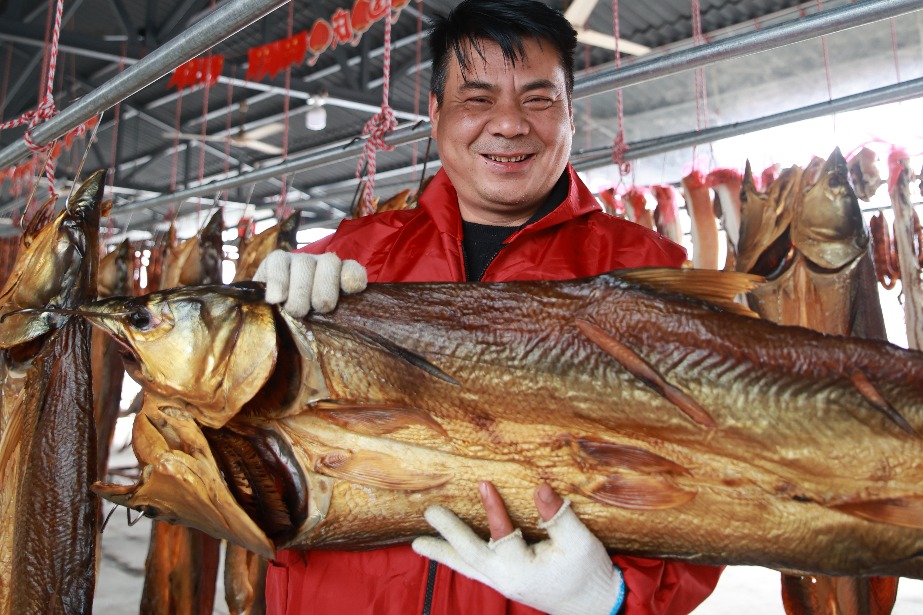
- Hunan's smoked fish and meat arrive in time for Spring Festival
- International arrivals to Guizhou skyrocket after visa-free policies
- Hubei deputy proposes museum of ancient Chinese law at Qin bamboo slip site