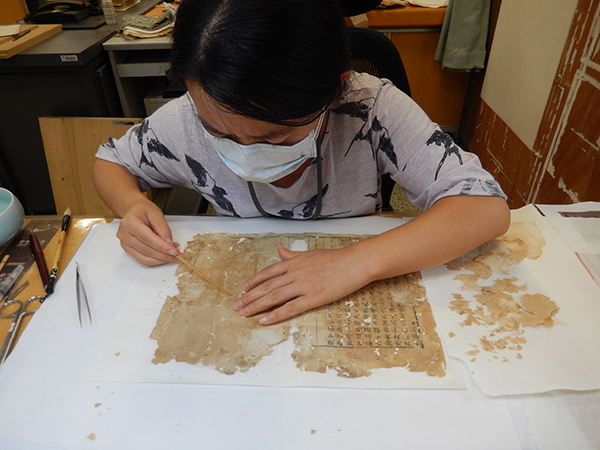
Five outstanding projects from the National Library of China, Tianjin Library and Shanghai Library were awarded the top honor, while 10 received the secondary award and a further 21 received a third accolade.
Nearly 100 restoration projects from 21 provincial-level administrative regions entered the final competition, and the result was decided by a 16-person judging panel, composed of the country's top-tier restorers and librarians of ancient texts.
Speaking of the criteria judging the restored books, Zhang Zhiqing, deputy director of the National Center for Preservation and Conservation of Ancient Books, emphasizes the importance of the guiding mindset more than a relatively intact appearance of the restored book.
"We'd like to see the restorers maintain a rigid and careful attitude toward the paper relics," Zhang says. "Old books should look old. We do not expect to see something overdone just to show off technique."
To avoid regret, caution is needed in restoration, especially when it comes to some priceless national treasures.
Among all the awardees in the competition, the work by Hou Yu--ran and her team from the National Library of China's restoration department was, arguably, the most important.
The 1.23-meter-long scroll, The Bodhisattva Maitreya's Previous Life in Tusita Heaven (first volume), was printed in 927 and came into the library's possession in 2015. The sutra is the world's second-oldest known dated printed work, only after the Diamond Sutra printed in 868, which is also a Buddhist scripture from China and now part of the collection at the British Library.
"It's a rare example of early-stage printed work," Hou says. "But its condition was complex when it was handed to us. It was broken, and its color was fading."
By analyzing the material, an ancient papermaking method using the bark of mulberry trees was adopted to produce new paper to make patches. An even bigger challenge was water stains on the scroll. In Hou's experience, it takes strong chemicals to get rid of them.
"For the safety of the paper, we decided not to pursue 'perfection' and left the stains there," Hou says. "People in the future will also be able to better understand what the scroll has experienced. It's key historical information as well."
In many cases, restorers find their work to be akin to a dialogue with their predecessors. Hou recalls finding a previous patch on the back of the scroll.
"Judging by the color and material, that restoration would not have been too long after this work was printed," Hou says. "But the way it was attached was sort of careless, so it had crumpled. The best way to deal with it was to simply make it flat and leave it in its original place."