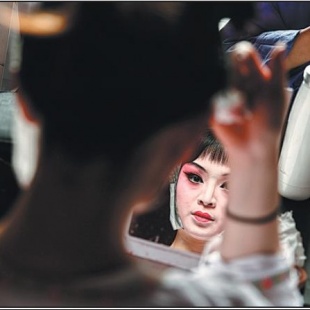



Rebirth of an ancient art










"If we make big changes to traditions, will that still be Kunqu?" Wei says. "Our duty is to fully display the beauty of the opera to the audience."
Tian says there are more than 10 professional Kunqu troupes in China, and over 100 Kunqu Opera societies have been organized by its fans nationwide.
Following a boom of many local opera genres in the late Qing Dynasty, Tian says the exquisite but relatively slow Kunqu performance gradually lost its luster on the stage of Changyinge in the competition of royal concerts.
In 1921, a group of artists established a Kunqu society in Suzhou and greatly contributed to its rescue by categorizing many classical scripts.
"However, with the lack of sustainable development, Kunqu was still on the edge of being buried in history when New China was founded," Tian says. "But a performance saved it in time."
In 1956, a Kunqu troupe from Zhejiang province performed a show in Beijing and received an overwhelming welcome. Premier Zhou Enlai hailed it as "an orchid in the garden of Chinese fine arts". In traditional Chinese culture, the orchid is used to symbolize the elegance and taste of the literati.
It was commonly reported in the media at that time that "a show makes an opera genre survive".
Recalling Kunqu's other monumental moment 20 years ago, Tian considers it not only marks the start of people recognizing the value of Kunqu, but also the earliest days of the Chinese society widely accepting the concept of the protection of intangible cultural heritage.
"At that time, many young people began to realize how brilliant our ancient arts were," Tian says. "It is thus crucial to strengthen our cultural confidence and encourage protection of traditional culture."