


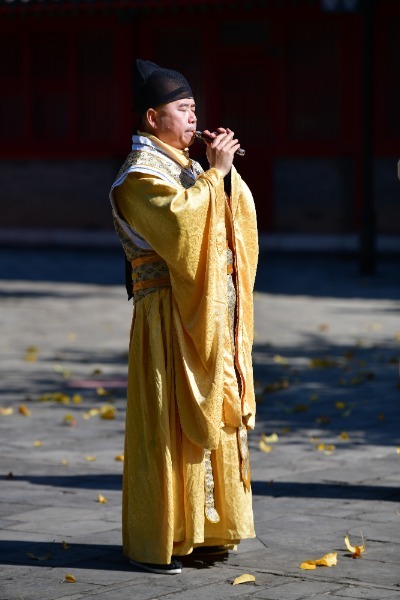
Like letters from heaven, score containing long musical notes hangs on the window of Hu Qingxue's office, which, for two decades, has also doubled as the backstage area for a band in Beijing's downtown.
Hu, 47, has played the music inscribed on the notation since he was 17. Called Jing Music, it has been preserved and inherited by consecutive generations of monks for 577 years.
Every day at 10 am and 3 pm in the Zhihua Temple, Hu, a 27th-generation inheritor of Jing Music, strikes up a band consisting of seven other musicians for a free, 15-minute performance given to visitors from both home and abroad.
Resounding and solemn, the music is passed down from generation to generation with verbal guidance and is usually played with wind and percussion instruments. All musicians who know about the traditional temple music first learned to sing the musical notation called gongche pu, a traditional Chinese notation system, before playing it with instruments.

Hu, who mainly plays wind instruments in the band, was born into a farming family in Qujiaying village in Hebei province. The village, about 100 kilometers from downtown Beijing, has preserved the centuries-old tradition since the Ming Dynasty (1368-1644) despite several periods of interruption.
In October 1991, as part of the Qujiaying Village Concert band, he performed at the Beijing Working People's Cultural Palace and encountered his future master, a monk from the Zhihua Temple.
"I remember that the monk musicians, in their 50s, from the temple, felt satisfied with our performance and that's why they decided to take us as their apprentices," says Hu.
Two months later, Hu and five other youngsters came to the Zhihua Temple to learn the art of Jing Music.
"It was not easy to learn the traditional music form," admits Hu.
"The skill to sing the notation did not come easy. Since the gongche pu was named for its use of 10 Chinese characters as pitch symbols, it takes apprentices up to seven years to be able to sing the notation proficiently."





