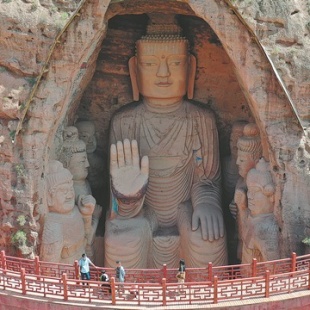



Restoring the faith
Tiantishan Grottoes get the attention needed to keep cultural relics in good shape, Wang Kaihao in Beijing and Ma Jingna in Lanzhou report.









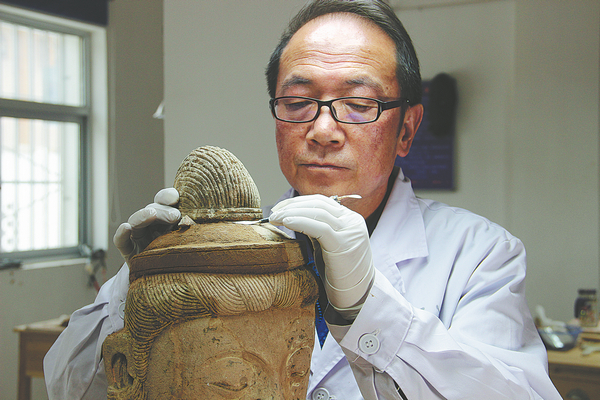
[Photo/China Daily]
Restoration program
A project to rescue the cluster of statues was launched in May 2020 and was completed in August. The program was led by Dunhuang Academy, an institution based in Dunhuang, Gansu, best known for its expertise in protecting the Mogao Caves, a complex of Buddhist grottoes and a UNESCO World Heritage Site thought to have been built between the fourth and the 14th centuries.
Unstable rocks were cleaned in Tiantishan's No 13 Cave. Frames made of waterproof material, such as fiber-reinforced plastics, were set inside the foundation of the statues. Pebbles were used to fill the frames and keep the ground water from rising.
A drainage system was also designed to usher the water in the statue's foundations into a well.
"It's impossible to thoroughly keep water off the statue," says Qiao Hai, the restoration program leader. "The key is to drain it smoothly."
Nevertheless, traditional material like mixed earth and foliage dominated the restoration. It was how the Buddha statue was built in the beginning.
Referring to old pictures and surviving Buddha statues elsewhere from the same historical periods, Qiao's team fixed the Bixi and Buddha's feet as well.
Though the feet were broken earlier, the renovation team decided to restore them.
"For integrity of the statue, we still preferred a beautiful and harmonious appearance," Qiao says.
"It took rounds of trials and expert appraisals before we chose the best method."
After the No 13 Cave of Tiantishan Grottoes was constructed during the Tang Dynasty (618-907), it had been renovated several times throughout the following millennia. And, completion of this most recent restoration does not mean the work is done once and for all.
"I cannot promise how many years the Buddha will be secure due to our restoration," Qiao says.
"But a scientific and dynamic monitoring system will closely follow how the statues' natural environment changes.
"Once we detect a problem, we'll fix it via restoration on a smaller scale. It's a long-term project, and prevention will play a key role."