


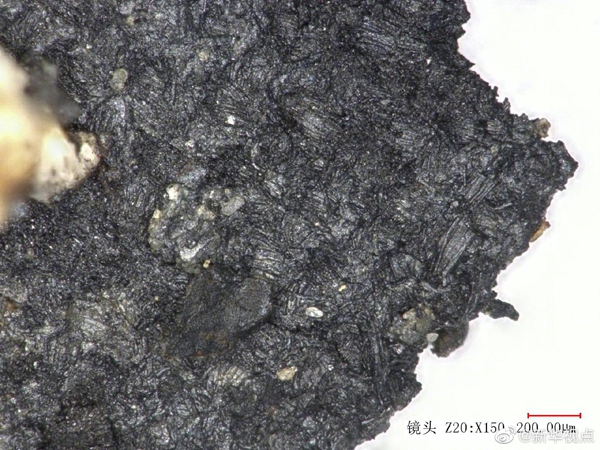
Using modern technology, Chinese archaeologists and researchers have restored silk fabrics from the Sanxingdui Ruins site in Southwest China's Sichuan province and unveiled them for the first time.
What appeared to be ash on the surfaces of gold masks, bronze wares and other artifacts uncovered at the site turned out to be silk, according to China's cultural authorities.
This is the first time silk and textile residue has been unearthed at the Sanxingdui Ruins, and the discovery advances the origin of silk in the Sichuan Basin to over 3,000 years ago, according to the archaeologists.
The new findings indicate the ancient Shu Kingdom was one of the important origins of silk in ancient China, shedding light on the unified yet diverse origins of Chinese civilization.
After over half a year of research, crew members from the China National Silk Museum and Sichuan Provincial Cultural Relics and Archaeology Research Institute found that there were mainly three types of fabric.
"We found three types of fabrics at the Sanxingdui Ruins site this time, namely Juan, Qi and braided fabric," said Long Bo, an associate research fellow at the China National Silk Museum.
Sacrificial objects with spiritual meaning
The researchers discovered the fabric found in the No. 8 pit was juan (tough silk) after restoring it on a computer, but the exact color is very hard to identify due to erosion.
Researchers at the China National Silk Museum used white and black pieces of paper to better show the structure of juan, and even illustrated how to produce it on site.
Zhou Yang, a research fellow at the museum said that silk was first used in sacrificial objects, and it was later used in tombs, as well as in ordinary people's daily clothing. The silk fabrics found at the Sanxingdui Ruins recently are sacrificial objects.
"The silk found in this sacrificial burial pit bears even more spiritual meaning, because we know that that scenario is for connecting heaven and earth, and connecting human and god, which has a certain religious meaning. So the silk found here is obviously different from those discovered in tombs or ruins," said Zhou.





