Initiative to drive robust global growth









President sets out actions, reforms to help countries address sluggish development
Editor's note: China Daily presents a series of reports illustrating how the Global Development Initiative proposed by President Xi Jinping will help countries around the world to shore up robust, green and more balanced growth amid unprecedented challenges. This is the second installment in the series.
Media buzzwords such as "loses steam" have frequently struck a public nerve worldwide recently in reference to rising commodity prices, disrupted supply chains, dwindling trade or shrinking job opportunities in a number of regions.
"If supply disruptions continue or inflation expectations become de-anchored, inflation may become more sticky," said Kristalina Georgieva, managing director of the International Monetary Fund.
The IMF said in its latest "World Economic Outlook" report, released last month, that the momentum of global recovery has weakened and "uncertainty has increased".
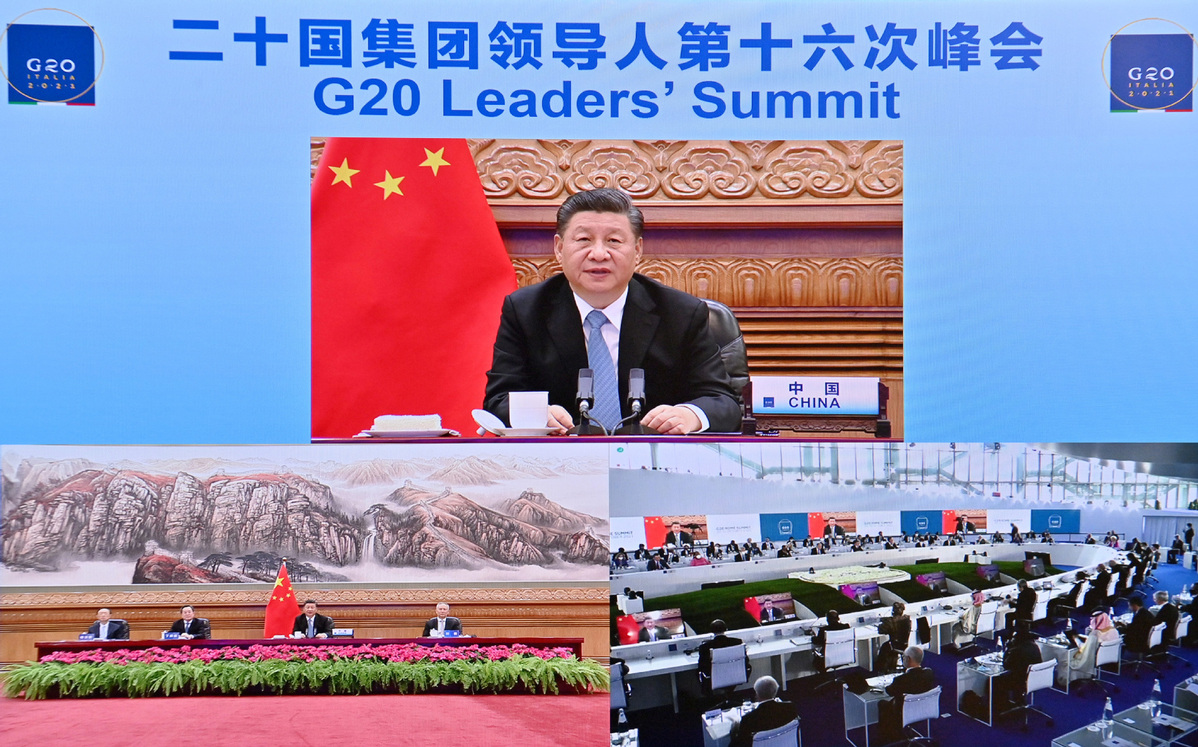
In an effort to respond to such concerns, in speeches to the recent G20 Leaders' Summit and the APEC Economic Leaders' Meeting, for example, President Xi Jinping has spared no effort to elaborate on China's fresh Global Development Initiative, which he said is for countries big and small to join and work together against widespread sluggish growth.
Under the initiative, which Xi unveiled in September, "staying committed to development as a priority" is listed first among the six aspects that countries should work for.
Xi has used the word "robust" when defining the goal of such concerted actions-pursuing "more robust, greener and more balanced global development".
Chen Fengying, a senior economist and former director of the Institute of World Economic Studies at the China Institutes of Contemporary International Relations, said this is "because development is a premium benchmark for all countries, and the world haunted by the COVID-19 pandemic will be in deep trouble if global growth fails to gather steam in a robust way".
Last month, the IMF lowered its forecast for global economic growth this year and next year to 5.9 and 4.9 percent, respectively, citing "a downgrade" for advanced economies as well as low-income developing countries "largely due to worsening pandemic dynamics".
To make things worse, "the speed of job creation is generally lagging to compensate for the earlier employment losses, especially in developing economies" over the course of this year, despite the gradual rebound of the global economy, according to the "World Economic Situation and Prospects" report released this month by the United Nations Department of Economic and Social Affairs.
Analysts said that Xi's detailed solution for prioritizing development, put forth at recent multilateral, global or domestic conferences, could be summarized as four pillars for global action.
The four pillars are coordinating for continued, consistent and sustainable macroeconomic policy; advancing and reforming a multilateral trade system; boosting infrastructure construction and connectivity; and stabilizing industrial and supply chains.
Ren Lin, head of the Department of Global Governance at the Chinese Academy of Social Sciences' Institute of World Economics and Politics, said, "The first two pillars-macro policy and trade system-h(huán)elp countries including China discuss what they can do to improve global economic governance."
The other two pillars-infrastructure and supply chain-"focus on China's future concrete actions that will motivate countries to follow", she said.
"We can't say any of these four pillars is less urgent or superior, because they all serve to answer how countries could set out to make initial breakthroughs toward recovery," she said. "They influence each other in a positive way when they function simultaneously to form a joint push to growth."
In a review of countries' recent macro policy, Chen, the senior economist, said that what worried her most is their lack of coordination-especially from some developed countries-in phasing out their own macroeconomic policies and stimulus packages that target the crisis triggered by the pandemic.
"Emerging markets and developing countries will suffer from remarkable capital outflow and devaluation of their currencies if the US Federal Reserve creates dollars at a speed beyond the world's expectation," Chen said of why Xi underscored policy coordination.
Global trade justice and order are also threatened as the World Trade Organization's role has been affected by protectionism and unilateralism in recent years.
Xi's call for advancing and reforming the multilateral trade system with the WTO at its core "is aimed at underlining what countries should do to deal with the risk of its coming to a grinding halt and dysfunction", said Ren, the CASS scholar.