The show was opened by the popular Chinese folk song Jasmine Flower, which was adapted for guzheng (plucked zither) and played by Chinese astronaut Wang Yaping aboard China's space station. Then, each of the 10 musicians from the orchestra played their own musical instruments, showing off their solid techniques. In the end, they performed together and were joined by more musicians, playing different musical instruments.
"The opening show rocked the night, which is cool," comments one fan on the orchestra's Sina Weibo account.
"I was impressed. Traditional Chinese musical instruments fit well with the atmosphere of traditional Chinese festivals," writes another viewer.
Traditional music is growing in popularity among the country's audiences, especially those from younger generations.
Over the last decade, Chinese musicians have been trying to revive, and be creative about displaying, traditional musical instruments, says Zhao Cong, president and principal pipa performer of the China National Traditional Orchestra.
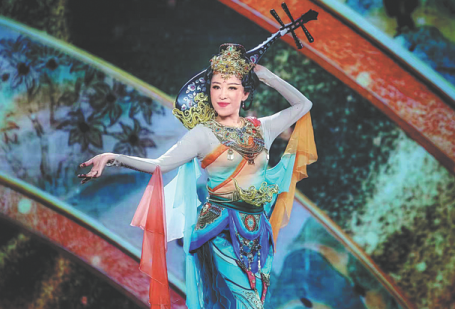
During the opening show, Zhao transformed into the role of "a goddess" playing pipa, a musical instrument with a history of over 2,000 years.
Instead of the usual way of playing the instrument, Zhao played it behind her head. Her image and the special way of playing pipa were inspired by a typical dancing posture depicted in the murals at the Mogao Caves in Dunhuang, Northwest China's Gansu province, which is a UNESCO World Heritage Site.
"I practiced yoga for months to relax my shoulders and my arms," Zhao says, adding that she learned to play pipa as a child.
"I am excited to bring the images I saw on photos (of the cave murals) to life," she says, adding that the instrument was imported to China through the Silk Road during the Han Dynasty (206 BC-AD 220).
Other musicians in the show included Feng Mantian playing the role of Ruan Xian, a scholar and a skilled player of the ruan (a plucked stringed instrument) of the Western Jin Dynasty (265-316), and percussionist Jin Hanbing playing the role of Liang Hongyu, a woman warrior from the Southern Song Dynasty (1127-1279).
"There are musical instruments that were born in China and also those that were imported from other countries in ancient times, which were later localized and became an important part of Chinese music," says Ma Jiuyue, composer of the music piece, Qi Tian Yue.
Ma adds that the 10 musical instruments in the show make different sounds and, when they are played together, the audience can enjoy the chemistry among them. The name of the piece refers to "sharing music together".
"In Chinese, the word yue, meaning 'music', can also be pronounced as le, meaning 'happiness', which is also a message we want to deliver. Playing music together is so much fun," Ma says.
"We took some important figures from Chinese history, which people are familiar with, and played traditional musical instruments to create a sense of freshness for the audience, who may or may not be familiar with traditional music," Ma says.
"I've read some reviews from the audience, especially young people, who shared their love for the performance."
The orchestra is dedicated to introducing traditional music and instruments to new audiences.
In 2008, Zhao and Ma worked together on an album, titled Sound of China: Dance in the Moon, which was released by Universal Music Group's China division. It was the record company's first album dedicated to traditional Chinese music, featuring famous pieces, such as Moonlight of Spring River and Ambush from All Sides.
"It was difficult to find a publisher because traditional Chinese music was facing a decline and was being challenged by contemporary music genres, like pop and rock," says Ma.
"Now, the album is selling everywhere, which makes us proud. More people appreciate traditional Chinese music. We never stop seeking new ways to showcase these old musical instruments."
Contact the writer at chennan@chinadaily.com.cn