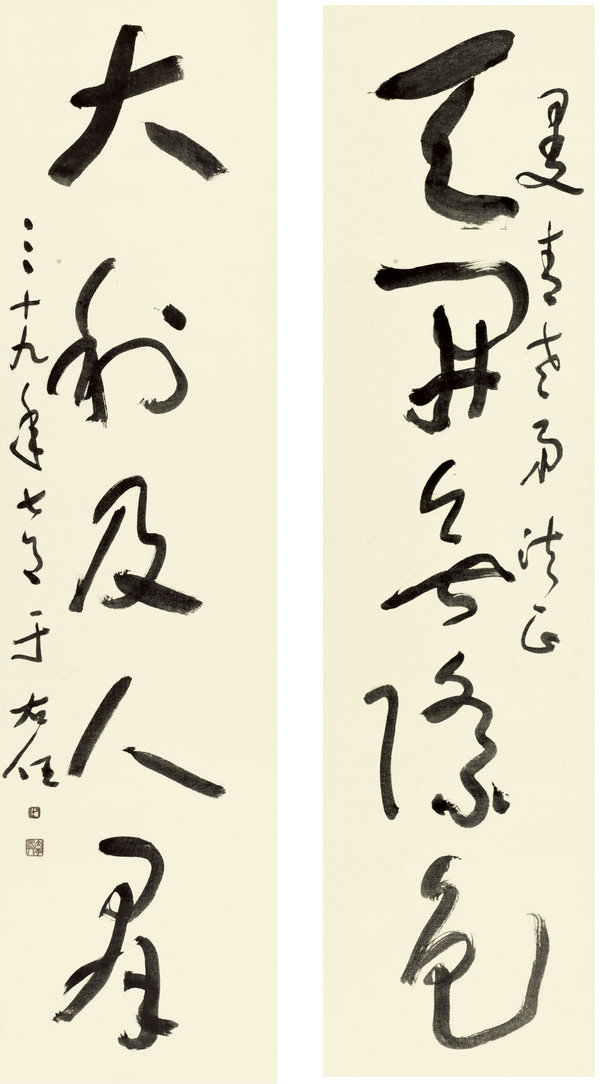
Yu Youren (1879-1964) is remembered and acknowledged as one of the key architects of China's higher education and is, also, ranked among the four great calligraphers in the first half of the 20th century.
Hailed a modern "saint" of caoshu ("cursive script") writing, he benefited from intensive study on, and practice of, various calligraphy styles on stele to form an exuberant brushwork marked with resilience and strength.
Yu didn't feel calligraphy was an area of exclusivity limited to certain groups of people. Instead, he viewed it as an important way of learning for all Chinese to understand the depth of their history and cultural traditions.
He developed the standardized cursive script in the 1930s, grounded on four rules. These rules were: being recognizable, easy to write, accurate and refined. By doing so, he hoped that the art of caoshu, with a history dating back more than 2,000 years, could be integrated into the daily life of modern Chinese.
Yu also founded the Standard Cursive Script Society in Shanghai, in 1932, with the aim of collecting fine examples of caoshu in history and to promote the style to Chinese communities at home and abroad, as well as to those who fancied Chinese calligraphy.
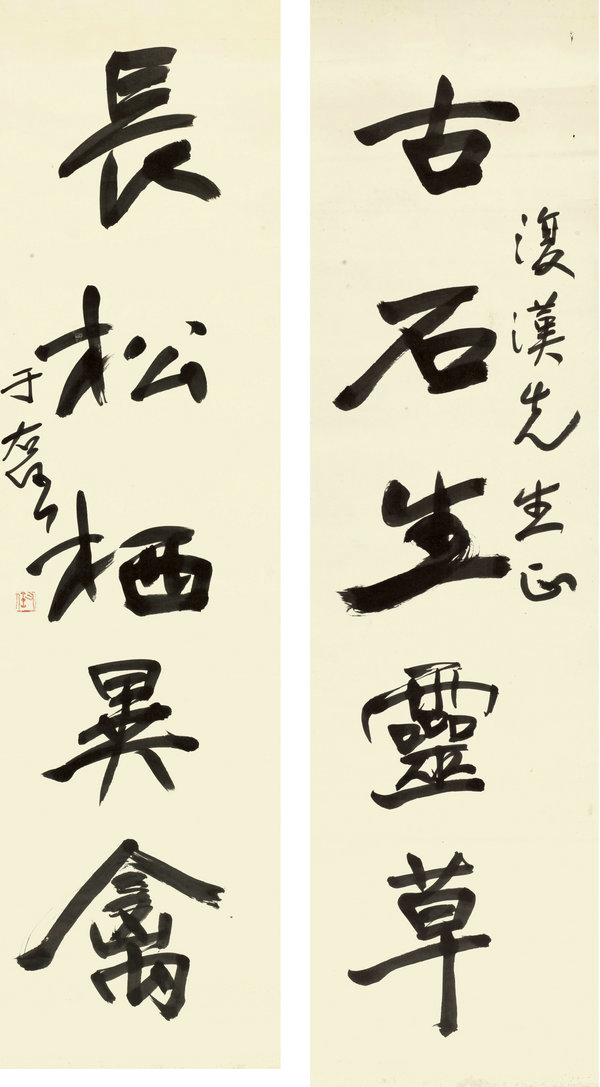
Let Cursive Script be Spread to the World, an ongoing exhibition at the National Art Museum of China till Wednesday, marks the society's 90th anniversary and the commitment to classic Chinese handwriting made by Yu and his fellow calligraphers.
The exhibition shows over 150 caoshu pieces, including 14 of Yu's own calligraphy from the collections of National Art Museum of China, Standard Cursive Script Society and Juntao Art Gallery, in Zhejiang province. It also gathers works by Yu's top students and renowned calligraphers, such as Liu Yantao and Hu Gongshi. Yu moved to Taiwan in the late 1940s, where he continued to promote Chinese calligraphy and the standard cursive script to the world. The exhibition also shows works by his followers overseas in Japan, Malaysia, Singapore and the United States.
Xu Liming, president of the Standard Cursive Script Society and professor of Nanjing University of the Arts, in Nanjing, Jiangsu province, says Yu reformed the old styles of caoshu, "not to achieve a breakthrough in the form of art, but out of his concerns with the needs of ordinary people".
Xu says Yu didn't ask others to follow his style of writing, but he encouraged people to develop their own styles of caoshu that exude personalities and modern sensibilities, by which the art of caoshu could be preserved, enlivened and spread out.
The National Art Museum of China has exhibited its collection of Yu's calligraphy on several occasions. Museum director Wu Weishan says characters are vital to the inheritance of culture and it is in the evolution of characters that people can learn about history.
"The standard cursive script is accessible for practicing and disseminating. In light of that, Yu's initiation of the society shows a commitment to his nation and culture," Wu says. "And celebrating the society's anniversary comes as an encouragement for people to learn about and practice caoshu as an important way to form a bond with our own culture and history."