


Mountain of relics










New findings
The listed heritage sites are only the tip of the iceberg. More untold stories are still waiting to be unearthed.
A city site in Qitai county, near the eastern section of Tianshan Mountains, known as Tangchaodun (or Tang Dynasty mound), is among the recent major discoveries. Since 2018, an archaeological team led by Wei Jian, a professor at Renmin University of China in Beijing, has chanced upon cultural relics at the site that are more than a millennium old and are proof of urban life.
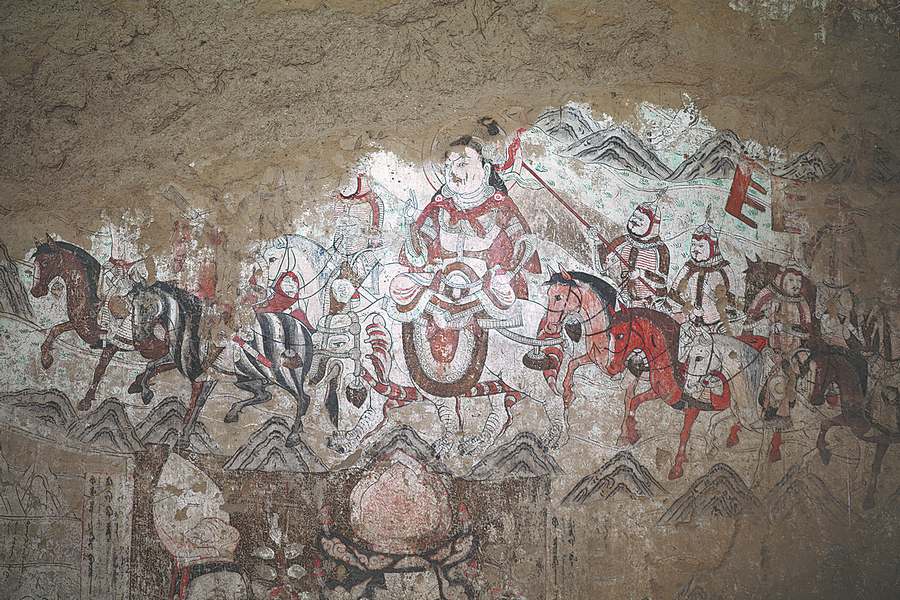
Surprising evidence of East-West communication has also emerged. Last year, a ruin of the Nestorian Church was unearthed at the site. It dates back to the 8th century. It was rebuilt a few times, but finally abandoned in the 14th century. A large number of murals, holy images with the cross, scepters, other Christian objects and old Uygur inscriptions have been found amid the ruins, which are typical of the Tang style.
According to Wei, the Nestorian Church, a branch of Christianity in Syria and referred to as jingjiao in Chinese documentation, was popular during the Tang Dynasty, but such religious ruins were previously unseen in Chinese archaeological research.
Another key discovery at the site-a bath built between the 10th and 13th centuries-has piqued interest. The complex comprises a brick main building and allied mud-brick buildings for other amenities, such as stoves and wells. They are characteristic of the Mediterranean region, like structures in ancient Rome. Wei agrees that the architecture of the bath was influenced by Roman style, but points out that several excavated artifacts are characteristic of Central China.
"You can see how various ethnic groups and religions coexisted along the Tianshan Mountains; how Eastern and Western cultures influenced each other along the Silk Road. They vividly portray the big picture of unity with diversity," he adds.
Mao Weihua contributed to this story.





