



Science serves as bedrock of China's targeted epidemic control









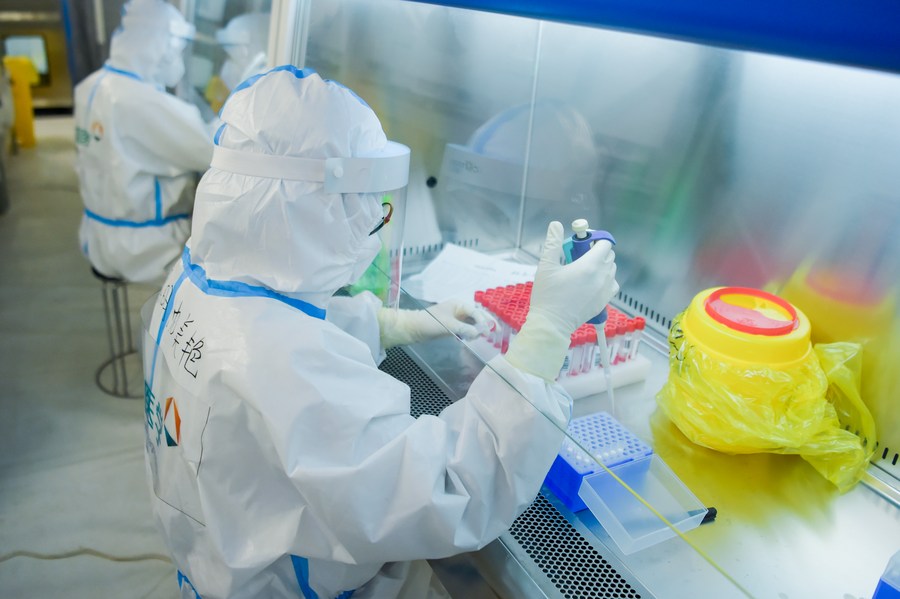
Science-based and targeted epidemic control has been playing a key role in China's endeavors to protect its people's health and strike a balance between epidemic control and economic and social development.
The Chinese mainland on Sunday reported 41 locally-transmitted confirmed COVID-19 cases.
If China adopts a hands-off approach against COVID-19, the consequence could be disastrous for a country with 1.4 billion people, including 267 million aged 60 or above and more than 250 million children.
China has carried out prevention and control measures based on scientific principles, as science has always played a vital role in the guidelines and policies issued by the central and local governments.
The dynamic zero-COVID policy has been proven effective in China's efforts to fight against the epidemic. The essence of the approach is early detection and quick response based on the characteristics of the virus variants, with aim of curbing flare-ups in the shortest possible time and at the lowest social costs.
According to China's newly-updated COVID-19 control protocol, the ninth edition released on June 28, close contacts and inbound travelers will be under medical observation in isolation at designated sites for seven days followed by three days of in-home health monitoring, significantly reducing the quarantine time.
Sub-close contacts will undergo seven days of medical observation under home quarantine, instead of seven days of medical observation in isolation at designated sites.
An expert with the Chinese Center for Disease Control and Prevention said the new edition was based on the latest prevention and control practices as well as the research outcomes, which found the average incubation period of Omicron variants was shortened to two to four days in most cases, and most of the Omicron infections could be detected within seven days.
The updated national-level protocol is the latest example of how China's anti-COVID efforts are based on science.
Scientific and technological breakthroughs, such as the development of rapid test reagents, vaccines and anti-virus drugs, have provided China with adequate tools for its prevention and control efforts against COVID-19.
They have aided the country in conducting quick rounds of nucleic acid testing, carrying out precise epidemiological investigations, effectively treating and curing the patients, and minimizing the impact of epidemic prevention and control on people's normal work and daily life.





