A big opposable thumbs-up for serious monkey business









The monkey was bouncing on my son's back like a trampoline. Then it bit him. (Fortunately, not hard enough to break the skin but rather just enough to leave tooth marks.)
Later, another macaque stole a sports drink from my wife's backpack, punctured the bottle with her teeth and shared sips with her tiny baby.
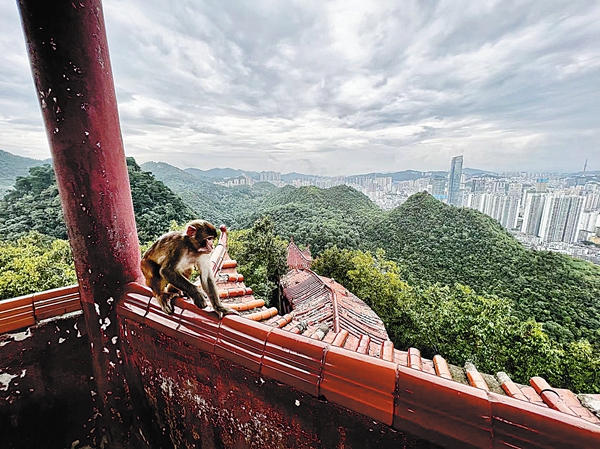
We spent the rest of the day watching these creatures roughhouse atop the roof of a mountainside pagoda, use saplings to catapult themselves into the forest canopy and trot nimbly across glass shards that topped a temple wall.
We were exploring the forests and holy sites of Qianling Mountain in Guiyang, Guizhou province, which is known as the home region of the mythical Monkey King.
Days before, we'd visited nearby Huangguoshu Waterfall, through which the fabled simian hero is said to have leapt to become the first of his kind to leave his kingdom. He went on to trek across much of the continent on an epic journey to retrieve Buddhist scriptures from India.
It's my favorite story from China featuring my favorite creature in the world.
Monkeys fascinate me profoundly because they're just so much like us. I'd only once encountered them outside zoos before coming to China, where I've enjoyed seeing them go wild in every sense of the term in several places across the country.
I remember photographing macaques on Emei Mountain in Sichuan province when I felt my wife digging through my backpack, which was strapped to my shoulders. I asked her what she wanted and said I could get it out for her. She didn't answer. Because it wasn't her.
I turned around to find myself face to face with a massive macaque whose limb was buried in the bag up to its furry armpit. Locals call Emei's monkeys "little thieves"-for good reason.
A struggle ensued, as I worked to wrestle the bag back from the creature. I was surprised by how powerful it was! It makes sense you'd have a lot of upper body strength if you spent all day climbing trees.
Soon after, my mother screamed as another monkey suddenly hopped into her arms.
Later that holiday, in Xishuangbanna, Yunnan province, we had a gibbon creep into our room to steal snacks while we were busy watching wild elephants destroy a restaurant in the jungle.
Another time, in Hubei province's Shennongjia forest-named after a semimystical man, Shennong, who's said to have sported horns jutting from his head, and is the ancestor of all Chinese and invented agriculture and archery-I was amused rather than offended when the locals pointed out the resemblance between my blond hair and the endemic golden monkeys' manes.
Shennongjia is also celebrated for another primate variety, the cryptid Yeren-Bigfoot's Chinese cousin-whose name literally translates as wild man or barbarian.
Years ago, I learned about a man-an ordinary guy, not an expert-who'd devoted his life to finding Yeren.
So, he camped in the woods, searching for evidence of the creature if not the hairy humanoid itself, trapping rats for food and only occasionally returning to civilization for supplies.
The irony is that he himself had become something of a wild man, with long snarled hair and a bristling beard from living in the wilderness.
For years, I hoped to interview this feral human. But he was virtually impossible to track down.
I've often wondered if Shennongjia's little golden monkeys, jinsi hou, inspired the lore of this giant bipedal ape-man, Yeren.
Indeed, the fact that people conceive of such beings as the yeti and their ilk suggests that we entertain a certain captivation with both how much other primates are like us and how much we are like them.
Simians appear like humans in ways that remind us we humans are actually animals, too. The notion of Yeren and his contemporaries seems to bridge, if not largely close, this gap.
In that way, they not only reassert our connections to other species but also within our own in ways that transcend culture or geography.