Solving the Jiankou jigsaw










Telltale tablets
In Beijing, the extant Great Wall runs for 520 kilometers and was built through a millennium, from the Northern Qi Dynasty (550-577) to the Ming Dynasty.
According to Shang, the Ming rulers began raising the Great Wall soon after the dynasty was founded. However, the fortifications were beefed up once tension began brewing between the dynasty and its northern Mongol neighbors in the 16th century.
Most of the surviving Ming wall sections in Beijing were reinforced during the reigns of Longqing (1567-72) and Wanli (1573-1620).The projects were led by the likes of Zhang Juzheng, the head politician of the imperial government, and the legendary general Qi Jiguang.
Extant historical documentation on the construction of the Great Wall lacks details. For instance, the construction time frame for the Jiankou section remains obscure in the records. Hence, researchers have to depend on field work to anticipate the time needed for restoration.
Stone tablets recently unearthed at the site suggest Jiankou was not built in a hurry. Inscriptions on one tablet indicate that beacon tower No 145 was erected in 1584. Another tablet inscription says the wall connecting towers No 143 and No 144 was constructed in 1597.
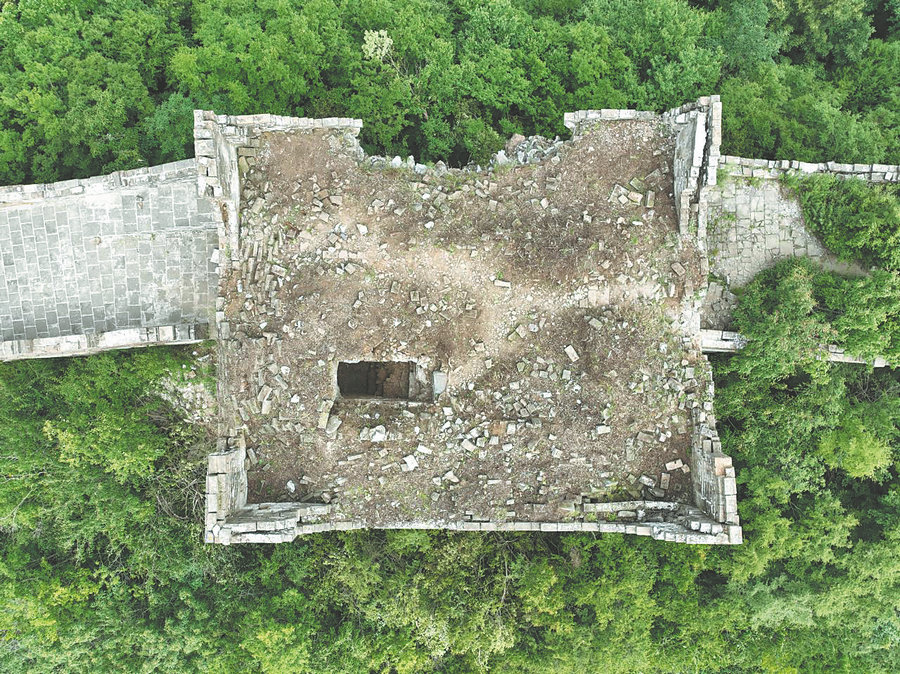
A tablet found during the third phase of Jiankou restoration in 2020 suggested that beacon tower No 127 was built in 1617. Another tablet, recently recovered from the half-collapsed tower No 156, shows it was constructed in 1573.
"Although the Jiankou section is not very long, it took more than 40 years and at least two generations to build. In short, individual fortifications were built before the entire Great Wall. It shows the evolution of a defense system," Shang says.
"Archaeological study tells us how a section of the Great Wall was built, developed, used, abandoned and, sometimes, collapsed — almost like a person's life. One gets an impression of the challenges that people faced in creating this architectural wonder."
The Great Wall offers a glimpse into the lives of soldiers stationed on the border centuries ago. On the top of a beacon tower, Shang's team discovered a hearth built to beat harsh winters. It was also used for cooking. "General Qi's books mention soldiers preparing meals on the Great Wall. Our find corroborates the historical record," he says.
Restoration efforts in the olden times were different. Collapsed portions of the Great Wall were often treated as rubble and cleared from the site, Shang regrets. Today, archaeologists are determined to preserve the ruins for future study. "As long as the ruins do not pose a risk to the structure, we will keep them. They are a key source of historical information," Shang says.