


Technician identifies Siberian tigers by fur patterns










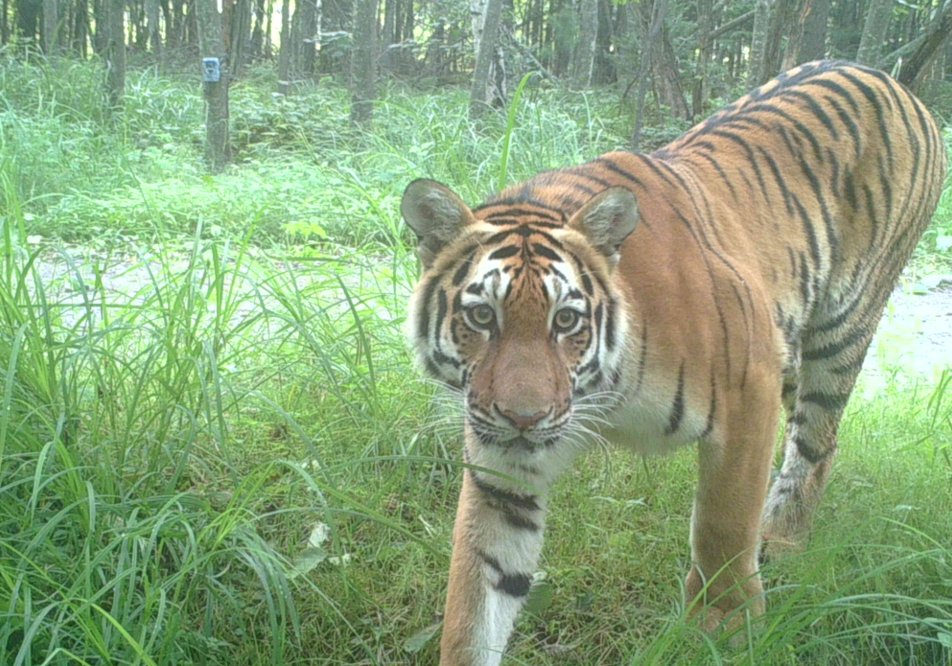
Every day, Duan Lianru spends several hours sitting in her office in Hunchun, Jilin province to make comparisons of hundreds of photos of Siberian tigers on the computer.
"It seems a little boring, but I really enjoy the work, which makes an intangible connection between me and the big cats," said the 36-year-old monitor from the research monitoring center of Hunchun bureau of the Northeast China Tiger and Leopard National Park. The park stretches across the provinces of Jilin and Heilongjiang.
Duan is responsible for identifying the tigers according to patterns on their fur and giving them exclusive serial numbers — something like an identity card.
"The pattern of the Siberian tiger is as unique as a human fingerprint," she said. "My work is distinguishing different individuals according to the position, length, width, color and shape of the patterns on the Siberian tiger's whole body."
The park, which includes more than 1.4 million hectares, is the most important habitat and breeding area for wild Siberian tigers and Amur leopards in China.
Over 5,000 infrared cameras have been set to record the living conditions of wild tigers and leopards in the Hunchun administrative region, which has 275,968 hectares.
"We need get both photos of a tiger's left and right sides to make sure that it is the same one," she said. "Sometimes, I can identify a tiger within one day, but sometimes it takes over half a year."
The Siberian tigers' "ID cards" come with a lot of information, including the animals' activity areas, food chain and mating conditions — important basic data that aids scientific conservation.
Based on such information, Duan draws the family trees of the tigers.
"In recent years, we have seen a remarkable increase in the variety and number of wild animals, thanks to improved conservation efforts," she said. "I can find more tiger families, including some back two or three generations."
"I feel quite honored to be involved in such significant work," she said. "I hope humans and wild animals can live in harmony to create a more beautiful world."
Xiao Kui contributed to this story.





