


Arts event provides hope to young Arabs









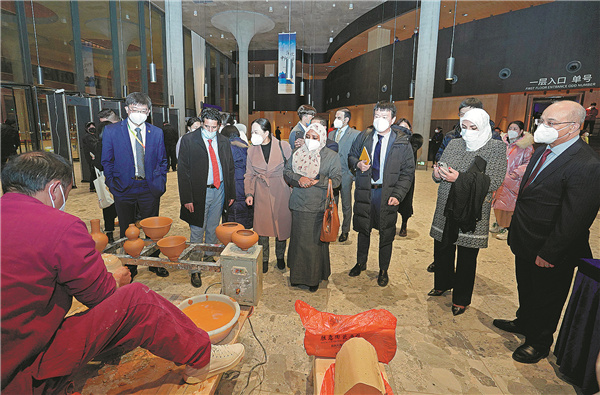
For Mahdy Ahmed Saleh, an Egyptian student studying in Jingdezhen Ceramic University in China, an array of Arab art activities held recently reminded him of his faraway home.
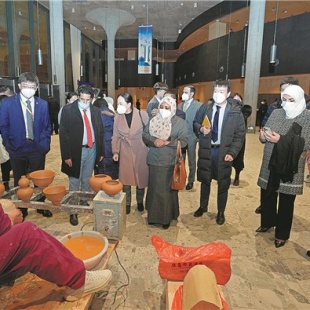
The fifth Arabic Arts Festival was launched last month in Jingdezhen, a Chinese city renowned for porcelain-making. During the festival, artists from Arab states showcased hundreds of pieces of fine works of art.
Special products from the Arabian Peninsula, including dates, camel milk products and olive oil, were also displayed in the market on the Taoxichuan ceramic art avenue of Jingdezhen in East China's Jiangxi province.
President Xi Jinping sent a congratulatory letter to the arts festival. "From the launch of the ancient Silk Road to the joint pursuit of the Belt and Road Initiative, China and Arab states have been working hand in hand, yielding fruitful results in people-to-people exchanges and cooperation," he says in the letter.
Xi expresses the hope that the two sides can take the fifth Arabic Arts Festival as an opportunity to deliver on the outcomes of the first China-Arab States Summit.
For Mahdy, who came to Jingdezhen in 2019 to further his education in cultural heritage and museum studies after graduating from Egypt's Fayoum University, closer exchanges between China and Arab countries mean more opportunities.
"Jingdezhen has a long history of contact with Arab states and that made me feel I belong here," says Mahdy. "For me, friendly China-Arab cooperation means that there will be more opportunities."
For a long period in history, the Silk Road, connecting Arab countries and China, acted as an important bond between civilizations. During China's Yuan Dynasty (1271-1368), smalt, an ingredient for making the Chinese blue-and-white porcelain, was imported from Arab countries.
Learning Chinese and the history of porcelain manufacturing is a rare opportunity Mahdy "had been longing for".
Mahdy's dream has come true, and as exchanges and cooperation between China and Arab countries are set to be further strengthened in the future, young people like Mahdy will enjoy broader prospects.
As cultural exchanges intensify, a greater number of Arab youths are exploring new opportunities by learning Chinese. Passant Sayed Khalil, champion of the 18th "Chinese Bridge" Chinese Proficiency Competition, is one of them.
"I want to help more Egyptian teenagers learn Chinese and understand Chinese culture," says Passant, who became a teacher in the department of Chinese language and literature at Cairo University.
The idea of becoming a teacher came from an unforgettable experience Passant had in Jiangxi province four years ago. At that time, she was an exchange student at Shandong University and had the opportunity to volunteer in Ji'an city, Jiangxi province, where she taught simple Arab songs to children in the mountainous region.
In September, Passant had a conversation with Chinese "taikonauts". She takes Liu Yang, China's first female astronaut, as her idol. "I consider the talk with the space station crew as one of my fondest memories," Passant says.
The young Egyptian woman says she always encouraged her students to learn Chinese and be more adventurous in experiencing other cultures.
According to a report on China-Arab cooperation in the new era, which was issued by the Chinese Foreign Ministry last month, China has trained 25,000 professionals of Arab states and provided about 11,000 government scholarships to Arab nations since 2013.
As of October 2022, four Arab countries have announced that Chinese has been included in their national education system, 15 Arab countries have set up Chinese departments locally, and 13 Arab countries have established 20 Confucius Institute branches and two independent Confucius classrooms.
Ma Jianfei, director-general of the Center for Language Education and Cooperation of China, says that there are 158 primary, secondary and kindergarten-level schools in the United Arab Emirates offering Chinese courses, and a pilot program for teaching Chinese has been launched in 12 public middle schools in Egypt.
During the first China-Arab States Summit held in Saudi Arabia, Xi said that China will work with Arab nations to advance eight major cooperation initiatives in areas, namely development support, food security, public health, green innovation, energy security, intercivilizational dialogue, youth development, and security and stability.