


Figuring out a legacy for Lord Rabbit










Inheriting the craft
In addition to publicizing the tradition, Shuang and his several apprentices have been swamped, trying to meet the increased demand for figurines of the Lord Rabbit during Spring Festival.
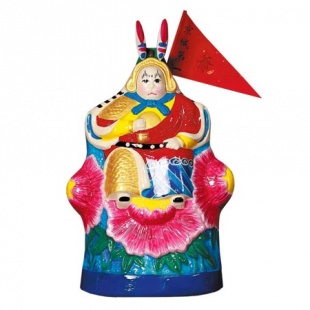
"The tradition dictates that Lord Rabbit from the previous year had to be sent away, meaning to be broken, because it is believed to have taken with it all the disease and disaster," Shuang says.
Therefore, the public usually expects a new one in the new year.
The manufacturing process can take up to a dozen of days.
First, the clay is brought back from suburban areas, such as western Beijing's Mentougou district.
Then, it is processed by being smashed and added with water to make a paste.
"After 10 days of precipitation, only the middle part will be used," Shuang explains.
Then, a dozen more steps ensue, including molding, polishing and applying the base color.
The last step is the color painting, which is the most crucial part, as it determines the mien of Lord Rabbit.
"The major colors are red, yellow and blue, all of which can be complemented by adjunct colors," Shuang says.
"Each Tu'er Ye will look different with the changes in its brows and eyes," he explains.
Shuang was immersed in the Lord Rabbit culture during childhood as he watched his father, a painted sculpture master, fashion artworks every day.
"My father would give me a lump of clay after school, and it would be an assignment for me to create something out of it," Shuang recalls.
"Afterward, he would check my work."
He says his father was tough on him and hoped that, one day, Shuang would surpass him.
However, at the time, the youngster frowned upon the loneliness and meager pay that came with the traditional craft, and he sought better opportunities in Shenzhen, South China's Guangdong province, where, in 1990, he managed to make 5,000 yuan ($741) a month by selling electronics.
It was 10 times as much as he would make in Beijing by making the Lord Rabbit.
Yet, two years later, his father called and asked him to come home.
"He said if I gave up, the Lord Rabbit might disappear," Shuang says.
After struggling with the problem for half a month, Shuang made a visit back to Beijing and he was acutely aware of his father's desperation and eagerness for someone to inherit the craft.
He cracked and decided to give up his business in Shenzhen to return home and carry forward his father's legacy.
Colored clay sculpturing craft of Tu'er Ye has been one of Beijing's more than 12,000 intangible cultural heritage items, and was inscribed on the national list in 2014.
As Shuang made inroads in the craft, he was enamored by its history and culture, and continued to hone his skills. In 2018, he was named a national heritage inheritor of the craft, which helped fuel his passion in preserving the original elements of the Lord Rabbit.