Giving cotton a new frame of reference









Traditional and modern
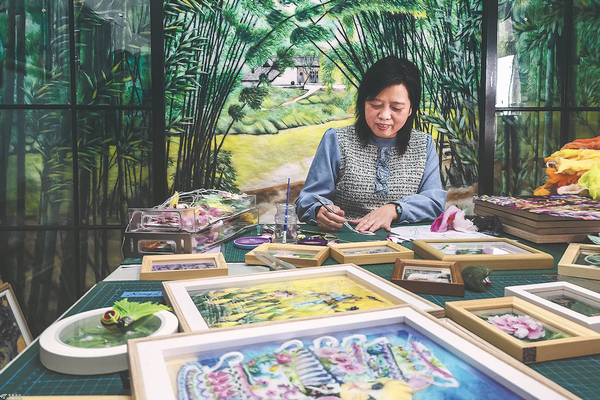
In the past, people in cotton-producing areas would dye cotton batting (layers or sheets) in their spare time and use various techniques to create traditional Chinese paintings in different styles, featuring auspicious flowers, animals and totems.
These paintings were often used as gifts to celebrate birthdays and friendship or express reverence for nature and aspirations for a smooth sailing.
The art form resembles a sculpture when seen from up close but a painting in the distance. It has been widely known as a "three-dimensional painting" in the country.
Liu Zhengjun, president of the Xi'an Intangible Cultural Heritage Protection Association, says the painting uses the crop as raw material and its inspiration is derived from folk customs, with simple rural life as its subject matter, all of which makes it a valuable art.
"Xu Hui's paintings of cotton wadding have a unique style," Liu says.
"After years of exploration, she has combined traditional techniques with modern aesthetics. She also uses a unique perspective from photography, forming her own style and opening up a new realm for the painting in the realistic sense," Liu adds.
After Xu graduated from middle school in 1988, her first job was making paintings of cotton wadding at a local plant. "It was more like a random opportunity, and I was able to study the craft at the plant's arts and crafts department," she recalls.
That was when she found it fascinating that ordinary cotton could be transformed into exquisite paintings.
"I was deeply impressed," she says.
With a deep passion, Xu, then 18, began to study the techniques with Li Futang, an inheritor of the Shaanxi painting of cotton wadding.
Li studied the art from Chen Bulan, who integrated cotton wadding craft from his hometown in North China's Hebei province with classical Chinese painting in the 1970s, Xu says.
More than a decade later, Li refined the craft by taking the integration up a level, Xu says.
"At that time, the paintings were usually large in size and mostly depicted tigers, cranes and peonies," she says.
It would take a team one or two months to complete a painting of cotton wadding.
"This period was the heyday of the traditional craft," she says.
However, as time passed, the painting slowly fell short of the aesthetic tastes of modern people and was on the brink of extinction.
She realized if the painting is to survive, innovation and creative efforts should be made to adapt the historical craft to the changes of the times.