Former mine site fosters a lush, green future









WUHAN — In early spring, Xiao Meng and his colleagues at the Huangshi National Mine Park in Central China's Hubei province were busy planting locust trees along with local residents at the former mining site.
"In the past, it was a barren, rocky wasteland. Now, the saplings I planted have grown into forests," the 58-year-old former miner says.
Xiao, now a security guard at the park in the city of Huangshi, has been planting trees on the site for nearly 40 years and has witnessed the environmental improvements taking place as a result.
The Huangshi National Mine Park was built on the site of the century-old Daye iron mine. Due to years of exploitation, three local mines became a trio of huge pits with an average drop height of over 400 meters, and over 300 million metric tons of waste rock had been dumped at the site.
"When the wind blew, the dust floated in the air, and when it rained, it turned to slurry," Xiao says, noting that the conditions not only harmed the health of the miners, but landslides and soil erosion also brought inconvenience and danger to nearby residents.
Yan Hongyong, who is in charge of the management office of the Huangshi National Mine Park, says, at that time, workers originally planned to plant vegetation to treat the problems caused by the rocky wasteland. However, the rock was hard and had poor water retention, so normal plants could not survive.
"After years of effort, local technicians found that locust trees, which are highly drought-resistant and nitrogen-fixing, thanks to their thick roots, were able to grow on these rocks," Yan says. Tens of thousands of people have since come to plant locust trees there every year, including the workers at the mine and local residents, Yan adds.
"However, due to the harsh environmental conditions, not every locust tree planted can survive," says Wu Fangqi, a 73-year-old retiree from the Daye mine site.
To improve the survival rate of the trees, people have dug large holes in the piles of waste rock, filled the pit with slag and fertilizer, and watered the locust saplings they have planted every few days, Wu says.
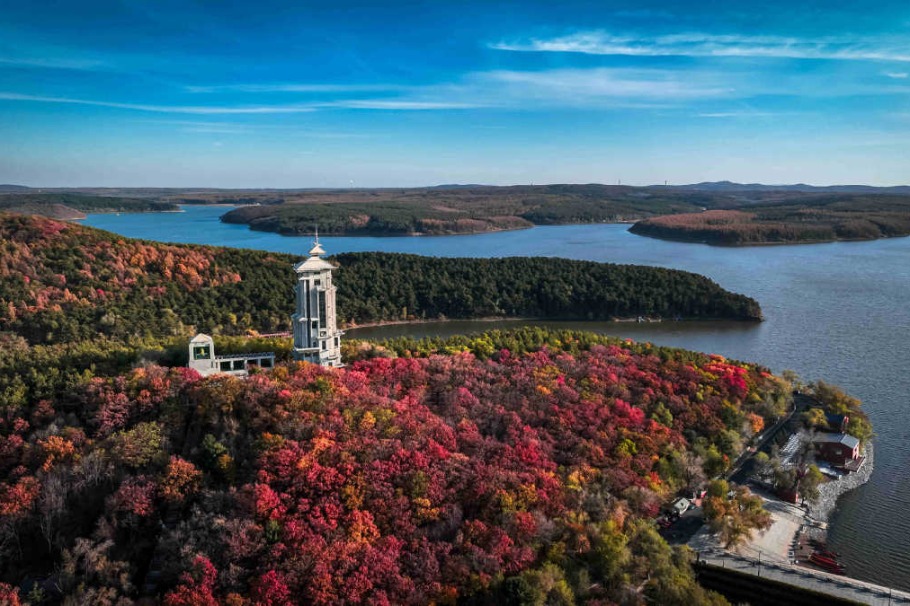
More than 1 million locust trees have been planted on the site over the past four decades, forming an ecological forest spanning some 3.6 million square meters.
Now, the former mining site has been turned into a tourist attraction.
"The Huangshi National Mine Park attracts more than 300,000 visitors every year," Yan says. "When the locust trees blossom, the park is filled with tourists."