


Sound of the past, note for the future










Not long after Shen was first attracted to the instrument, he decided to learn it. In the 1990s, when internet usage was not widespread in China, learning a less popular instrument was not an easy task, not least because of the scarcity of nearby teachers.
Besides teaching himself and listening to tapes to compare and improve, Shen embarked on trips to visit those who gave compelling performances he heard on tape, and received tutoring from masters in this area, such as Song Jinglian, Luo Shoucheng and Chen Hangming.
Since he had to study at school and then work to support himself, he could only undertake such trips in his spare time. As a result, the learning process spanned his 20s. "It was very tiring. Without high-speed trains, common today, I had to take a train for more than 20 hours to Beijing, or other places, to visit people. But I was resolute to take this road. I wanted to improve my skills and learn more," says Shen.
While learning the instrument, Shen was increasingly fascinated by the rich cultural connotations contained in the xiao. According to him, a scene from a TV series of a literate person piping the xiao in the moonlight, an image full of elegance and poetry, evoked his romantic imagination and has been engraved in his heart since childhood. And that reflects the close relationship between this instrument and the literate in times gone by.
In ancient China, bamboo symbolized integrity, modesty and a spirit of striving to make progress. As a result, many liked the plant and used it to refer to their pursuits in poems. For example, Song Dynasty (960-1279) poet Su Shi once wrote, "Better to eat without meat than live without bamboo", suggesting the importance of bamboo in their hearts.
Therefore, the xiao, made of bamboo, was much more than an instrument, but something they often held in hands or put on walls to remind themselves of their pursuits, and they sometimes used xiao to refer to themselves in poems as well, according to Shen.
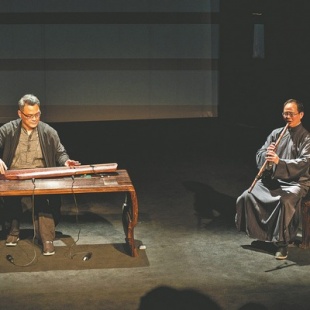
"Since the Tang Dynasty (618-907), the xiao was often used in gatherings and meetings of the educated and literate, just like the guqin. It was so popular then that if one was not able to perform it, they were regarded as old-fashioned," says Shen.
During his learning process, Shen summarized his experience, which paved the way for his later teaching career. In 2000, with the growth of his stature, he was invited to teach dongxiao, a genre of xiao popular in the Jiangnan (south of the Yangtze River, in its lower reaches) area of China, at an art school in Hangzhou. A year later, he established the Xixi Xiao Society with his students to better promote the instrument.
Although the xiao was once popular in history, it gradually fell into oblivion. Nine major conservatories were established in the country after 1949, when the People's Republic of China was founded, but it was not included as an independent subject for music education.