


Culture down to a tea









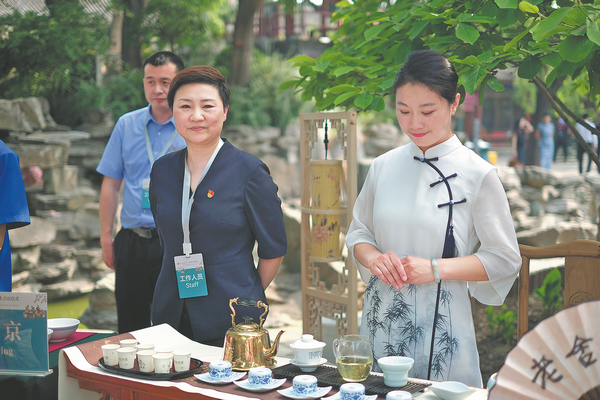
"Tea culture has played a key role in the social development of many civilizations along the Silk Road, promoting exchanges between people and fostering mutual learning," says Shahbaz Khan, director and representative of the UNESCO Multisectoral Regional Office for East Asia, in a speech at the event.
At the salon, which delved into tea culture, a symbol of harmony, equilibrium and pursuit of inner peace, he said that he hopes to gain a deeper understanding of the value of tea, not only as a delightful beverage, but also as an embodiment of cultural heritage, identity and continuity.
Among the tea stalls at the event, that of Zhang Zhifeng, from East China's Fujian province, received considerable attention. His wares seemed closer to art than a common drink.
Guests were invited to join him and try their hand at the tea art known as chabaixi. By whisking powdered tea together with water in small quantities, a layer of foam emerges on the surface of the liquid. On this natural canvas, one can gently run a bamboo teaspoon across the surface, writing Chinese characters or painting delicate flowers, birds or landscapes, turning a cup of tea into a tasteful work of art.
For nearly 40 years, Zhang has been devoted to the preservation of this technique, the earliest mention of which is in the records of the Tang Dynasty (618-907). The art reached its prime in the Song Dynasty (960-1279).
He was first drawn to chabaixi while at university, where he majored in tea science. His introduction to the art was accidental — he stumbled upon mention of it in an ancient record. Learning that the technique was on the verge of dying out, he started researching it, and dedicated himself to restoring it.
This proved challenging, as records about chabaixi were fragmented and scattered across many different ancient poems, chronicles and paintings. He had collected several thousand relevant records by the time he made his first attempt to re-create the technique, in 2008.
Zhang says that chabaixi holds rich historical, artistic, scientific and social significance. It not only serves as a reference for ancient people's aesthetic tastes, tea-making techniques and other ways of life, but also embodies the ancient Chinese values of purity, reverence, harmony and beauty.
In the past, he has met visitors who mistook the technique for latte art, but they are not the same. This ancient technique uses clear water to create the patterns, without in any way changing the tea's essence.