


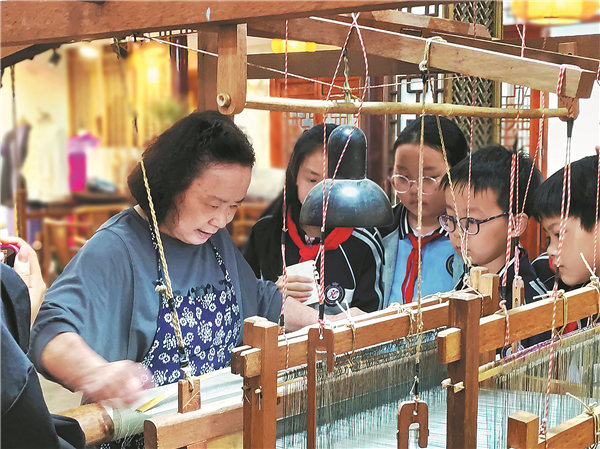
Craftsmen must often immerse their hands in water, even in the cold winter, resulting in chapped and cracked skin on their hands. Most people cannot endure such discomfort, and many potential silk makers quit.
Due to the complexity of the process, the weaving technique of hangluo was almost lost. Yet, inheritors like Zhang and his parents-in-law, Shao Guanxing and Hong Guizhen, are striving to keep the craft alive.
In the 1980s, Shao and his wife, Hong, the fourth-generation representative inheritors of hangluo craftsmanship, managed to restore and improve the manual loom technique through persistent practice.
Originally, it took a skilled craftsman eight hours to hand-weave approximately 80 centimeters to 1 meter of gauze. After the family's improvement, around 8 meters can be woven in the same amount of time.
Shao, who was born in 1954 into a family of craftsmen in Hangzhou, grew up in a weaving workshop. Since his grandfather learned the weaving technique at the end of the Qing Dynasty (1644-1911), the family has been practicing the craft for over 150 years.
The technique is considered "a means of subsistence, which cannot be stolen, cannot be burned, and will always keep us from starvation", Shao says.
His early memories were filled with scenes of nearly every household in the Genshanmen area producing hangluo. His father would pull a cart filled with the fabric to the nearby canal dock to sell it. With the money he'd receive, he would buy some oil, salt, rice, meat, and other groceries.
Shao loved following his father to sell hangluo, which allowed him to visit the city center and witness the bustling silk trade at the canal dock. His father would usually buy him a few candies, which were incredibly precious in an era of material scarcity.
This childhood memory, filled with warmth related to hangluo, encouraged him to collect and preserve the remaining eight traditional wooden looms from that time. In 1984, he expanded his family's small workshop into the Fuxing Silk Factory.





