Museum puts the excitement into excavations









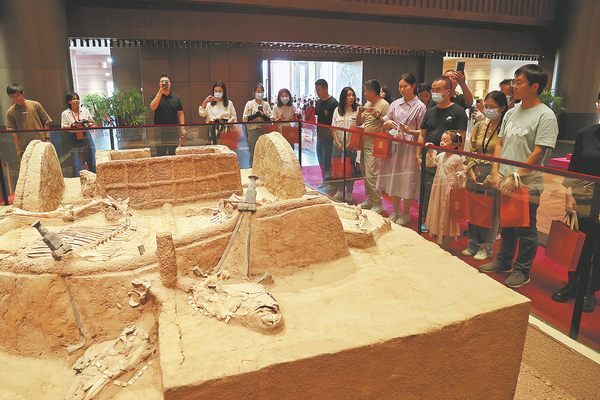
Visitors are able to get visual, audio and tactile experiences of many of the objects on display.
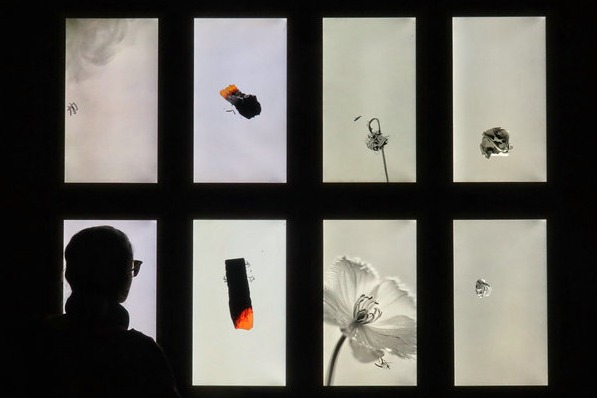
"In the exhibition halls, the museum also attempts to engage visitors through means such as video presentations, multimedia interactions, scene simulations, OLED transparent displays and visual 3D," Gong says.
For instance, in the Stone Age exhibition section, visitors can immerse themselves in interactive videos simulating the process of making tools.
Near the oracle bone display, a vicarious experience of the divination process of the people of the Shang Dynasty is presented through multimedia devices, which adds extra excitement.
The display of archaeological findings from the Sui and Tang dynasties (581-907) from Henan province's Luoyang city includes a re-creation of a historical road outside an ancient city gate, complete with wheel ruts and camel footprints.
Electronic displays and 3D technology enable visitors to zoom in on small and delicate details and virtually turn artifacts around with their hands.
"These methods help visitors connect emotionally with Chinese civilization, strengthening cultural confidence, enhancing national pride, and solidifying the determination to achieve the great rejuvenation of the Chinese nation," Gong says.
The dense warehouse-style display cabinets and racks in the exhibition hall that complement the multi-angle presentation of independent cabinets are another distinctive feature at the museum.
The warehouse-style display shows the characteristics of archaeology as a discipline, she says.
"Archaeological research often involves the comprehensive study of a group of remains and artifacts distributed within a specific area over a certain period of time, which are characterized by their common features," Gong explains.
"This means that they should be studied according to the cultural context of archaeology, with a focus on the series and types of remains and artifacts, rather than by isolating and appreciating individual objects," she adds.
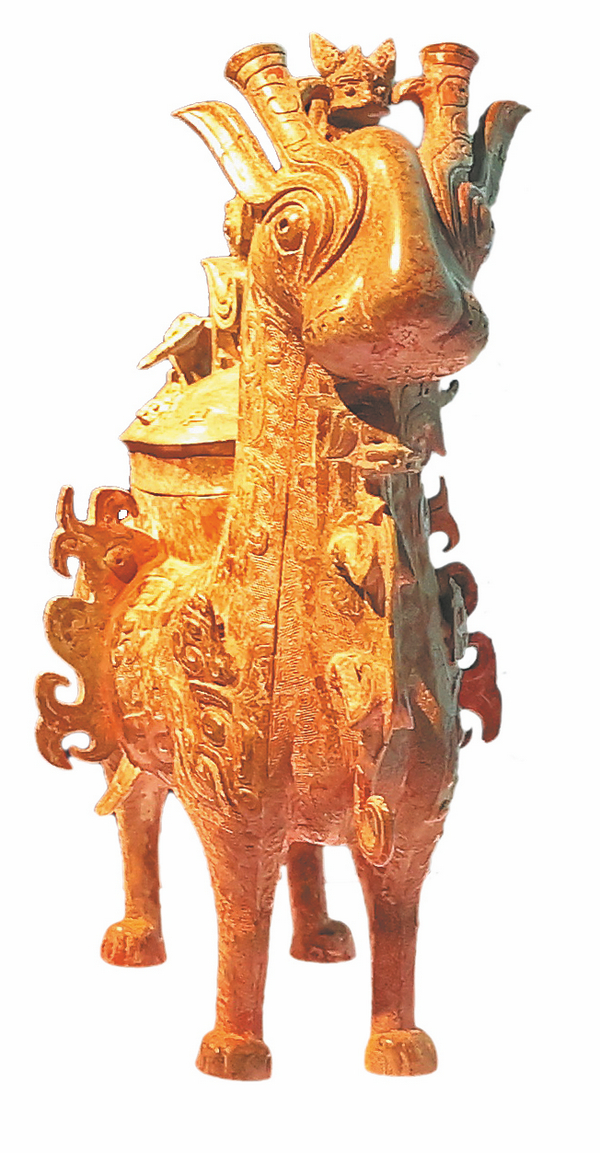
Consequently, the displays at the Chinese Archaeological Museum don't highlight isolated artifacts. Instead, they fully consider the cultural context of archaeology and archaeological sites, striving to achieve an organic integration of artifacts and grouped objects, accompanied by auxiliary layouts through diagrams and explanatory illustrations.
"This approach allows for a comprehensive archaeological interpretation of the entire spectrum of social production techniques, aesthetic preferences, religious beliefs, social organization, values, cultural traditions, and their formation and development," Gong says.
Cheng Xueyang, a history student from the University of Chinese Academy of Social Sciences in Beijing, felt lucky to be able to visit the museum on its opening day on Sept 15.
"The visit is a good complement to my experience," Cheng says.
Cheng adds that she was excited to see some of the objects, which she had only seen in textbooks before.
"All the abstract nouns from the books become independent objects here, vividly emerging before your eyes," she says.
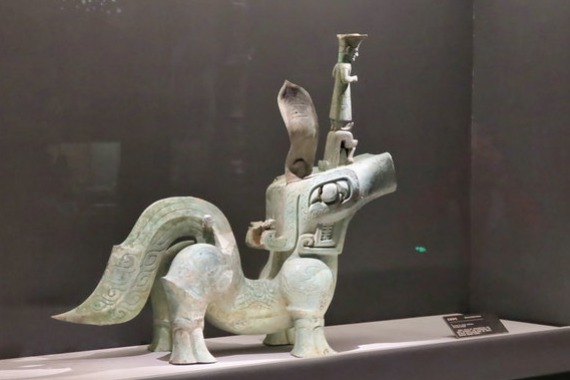
Zhang Jinyang, a sophomore student from Beijing, had his eyes set on seeing the turquoise mosaic dragon from Erlitou during his recent visit.
"I've been looking forward to seeing its true appearance," Zhang says, adding that words didn't do justice to its beauty.
He says he felt the exhibition was very well done and vividly displayed the profundity and extent of Chinese history and culture.
"I also noticed innovative, interactive approaches, such as the way they make the text on the pottery jars appear on the display cabinets, which is very impressive," he says.
According to Gong, the museum will continue to use advanced technology to build a bridge between archaeology and visitors, and vividly present Chinese civilization.
A foundation platform for an intelligent guided tour and explanation system will be created this year.
"Through big data analysis, we aim to provide personalized tour route recommendations to visitors, and indoor positioning technology will be combined to offer mobile-guided tours," she says.
Digital technology will also be applied to some key artifacts, so 3D data will be integrated with historical information and textual and visual content to create multidimensional presentations to reveal the stories behind them.
"In the future, we will continue to explore the use of new technologies and methods, such as VR, AR, and data-driven approaches, at the museum," Gong says. "Meanwhile, we will continue to experiment with various forms of display."