


The taste of a more fulfilled life









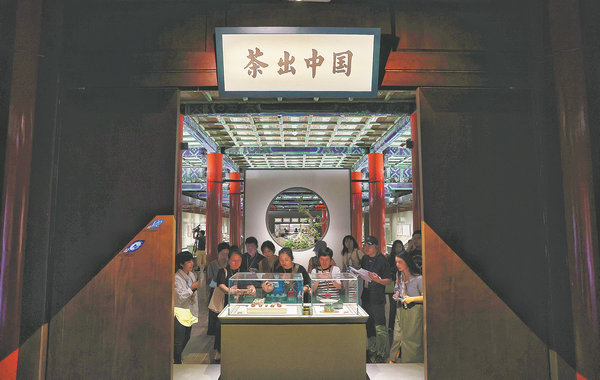
In the first section, many items unearthed at archaeological sites are on display to show the origin and development of tea culture in China.
This is often linked to the myth of Shennong, who is regarded as the father of agriculture and traditional Chinese medicine, and who was said to have discovered the medicinal use of tea leaves in ancient times. Tea tree roots unearthed at the Tianluoshan site in Yuyao, Zhejiang province, have pushed back the beginning of cultivation to about 6,000 years ago.
A bowl with remnants of tea leaves discovered in a tomb in Zoucheng, Shandong province, proves that as early as 2,400 years ago, people were drinking tea. Whether they did so for medicinal reasons or as a beverage has yet to be determined.
Since the Han Dynasty (206 BC-AD 220), methods of brewing tea have developed along various lines from cooking, frying, and grinding leaves to powder to boiling them in hot water, depending on the lifestyles of different dynasties.
Many items on display show that tea was already a popular beverage in the Tang Dynasty (618-907). Given the exquisite tea sets dating to that period and ancient paintings depicting elite entertainments, it was especially appreciated by the upper class and the imperial family.
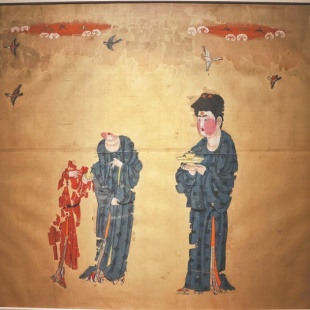
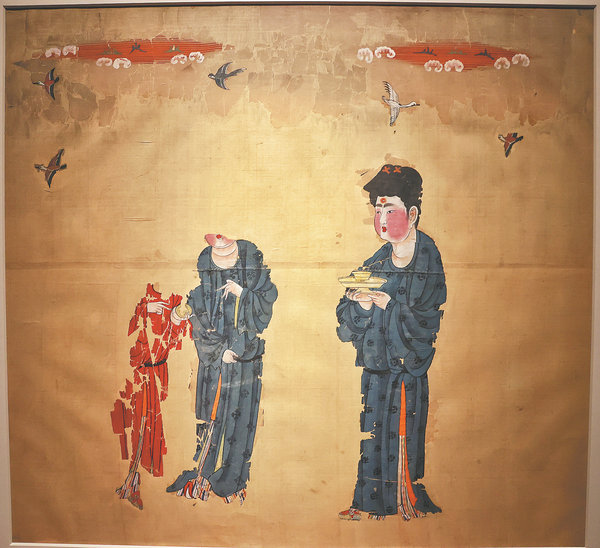
In the Tang Dynasty painting Maids Holding Teacup and Saucer, a maid waits to serve her lord tea. The painting, found in a tomb in Turpan in the Xinjiang Uygur autonomous region, vividly demonstrates that drinking the beverage was common in western China more than 1,000 years ago.
Wang says that drinking tea involves more than just preparation and beautiful utensils, and also reflects the philosophy of how the Chinese relate to the outside world.