


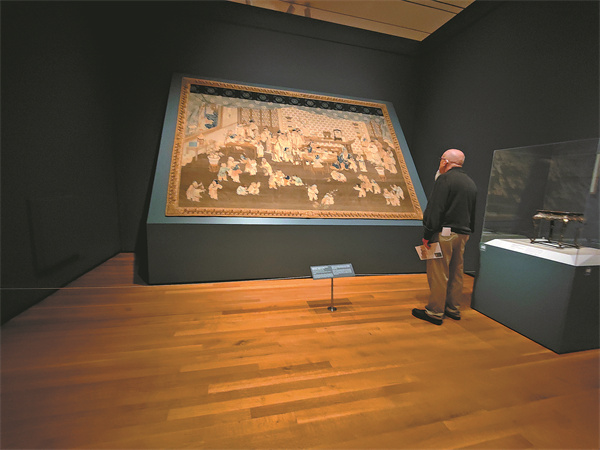
One exhibit stands out from the ongoing exhibition China's Southern Paradise: Treasures from the Lower Yangzi Delta, on view at the Cleveland Museum of Art. It is a map — a rubbing to be exact — of China's earliest surviving city plan to have been engraved on a stone slab. Within an area of 5 square meters, the rubbing, created in the first half of the 20th century, depicts modern-day Suzhou, featuring six water gates and more than 300 bridges, validating the city's entitlement to the name "Venice of the East".
For centuries up to the point when the map was made, Suzhou had acted as a commercial center of Jiangnan, the term denoting the southern part of the lower Yangtze River Delta, the region examined by the exhibition at the CMA.
And for people who have traced the region's history to antiquity, the concept of water gates is anything but new. Back in around 3000 BC, the ancient people of Liangzhu, who first realized the potential of the land, erected on it a grand city, before furnishing the inner city walls with eight water gates — two on each side — to facilitate transportation conducted over a dense network made up of both natural and man-made waterways.
Today, what remains of Liangzhu City still evokes the heroic efforts involved in turning this place into a home, including building stilt houses, digging aqueducts and cultivating acres of swampy land to grow domesticated rice, whose carbonized form can still be seen today.
"The water element provides an undercurrent to the storytelling of Jiangnan," says Wang Ningyuan, who has led the excavation at what's known today as the Archaeological Ruins of Liangzhu City, a UNESCO World Heritage Site.
Judging by what has been discovered from the waterlogged underground silts, the ancient Liangzhu people traveled on flat wooden rafts, measuring at about 0.5 meters wide and 2 meters long. They probably still did when Yue Jue Shu (the Book of Yue) was compiled somewhere between the 1st and 3rd centuries, in which it was rightfully noted that "the Yue people (from the south) tamed boats the same way the Hu people (from the north) tamed horses".





