Workers bring energy, prosperity to region's residents









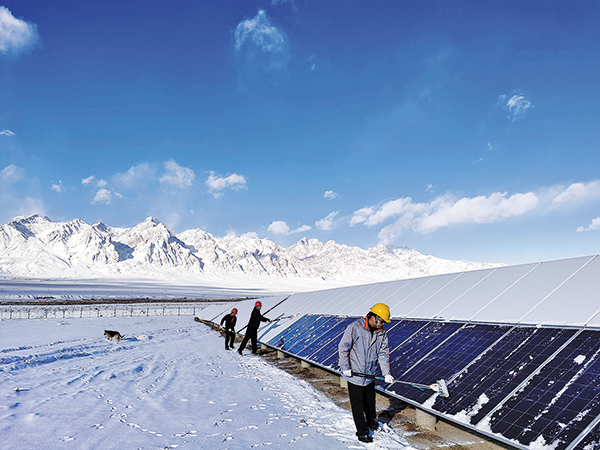
Yan Yuzhi and his five colleagues celebrated this year's Spring Festival atop Pamir Plateau in the Tashikurgan Tajik autonomous county of Kashgar prefecture, Xinjiang Uygur autonomous region. Their job is to maintain and operate a photovoltaic power station that is fueling the local economy.
With so few people around, the quiet surrounding the station around 3,300 meters above sea level is only interrupted by wind and the occasional barks from dogs running below the vast rows of photovoltaic panels.
"We need to maintain normal operation of all equipment and guarantee stable power supply for residents in the county during the holiday," said Yan, a safety supervisor engineer and deputy head of the station.
The station offers more than electricity.
In 2017, the Futian district of Shenzhen, Guangdong province, invested 90 million yuan ($12.5 million), and the Shenzhen Energy Group added 84 million yuan, into building the station as the first centralized power station for poverty-relief purposes in Xinjiang.
Since being put into operation in May 2018, all of the station's distributive profit has been given to the county government to create jobs, establish educational funds and critical illness medical funds, and conduct other projects related to rural vitalization. The nonprofit mode will last 20 years through 2038 and is expected to benefit more than 16,000 people from about 4,000 families.
So far, the station has produced over 250 million kilowatt-hours of power with an annual average of 40 million kWh. As of the end of 2022, it had paid 19.59 million yuan to the county government, according to Yan.
The money is used as salary for about 900 residents working as forest rangers, border guards, childcare workers and other posts, and it is used to promote a collective economy for 47 villages and to finance nonprofit projects, he added.
Thanks to the project, Jerap Bayrak, 27, became a security guard in his village in July 2023, earning an additional 1,900 yuan monthly.
"I used to grow wheat and barley at home, raise yaks, and sometimes do odd jobs. The income was not very stable. Now, with this fixed income, our whole family's life is improving," he said.
Xarwana Marwanjan, 26, is one of the two employees hired from the county. After graduating from college, she once worked as a kindergarten teacher and at a tourist center. In 2020, she applied for a job at the station. Now, she is an operation and maintenance engineer.
Joining the new energy industry has been very challenging for her, and she has learned a lot.
"The electricity generated here is all used for the development of our county. I feel that working here is very meaningful," she said. "The station often provides training to help us better master the skills required for the job."
According to Yan, 12 employees maintain the station's operation. Each person works for 16 days and rests for 14 days per month.
At an average altitude of 4,000 meters, Tashikurgan is known as the county closest to the sun. Because of the harsh environment with thin air, frigid temperatures and poor traffic, residents used to live impoverished lives. However, the county has rich solar resources, providing about 4,434 hours of sunshine annually.
"Tashikurgan is an ideal place for developing photovoltaic power. The annual average utilization hours of power generation equipment far exceed those of other areas in Xinjiang," said Yan.
During the holiday, the workers have been making daily inspections and troubleshooting, according to Yan. The station has 77,760 photovoltaic modules in an area of 42.3 hectares.
"In the past, workers had to patrol a 42-kilometer distance each time. We also used telescopes to look for smoking or malfunctioning solar panels. Last year, we introduced drones, which help us inspect the entire area in just half a month," said Yan.
Since 2010, Shenzhen has assisted in developing Kashgar city and the Tashikurgan Tajik autonomous county as part of a national program enlisting 19 provinces and cities to help Xinjiang.
As of early November last year, Shenzhen has invested 12.665 billion yuan and participated in 894 aid projects in Xinjiang, leading to an investment of over 31 billion yuan from enterprises and 637 million yuan in social donations, data from the command headquarters of Shenzhen's paired assistance to Xinjiang showed.