


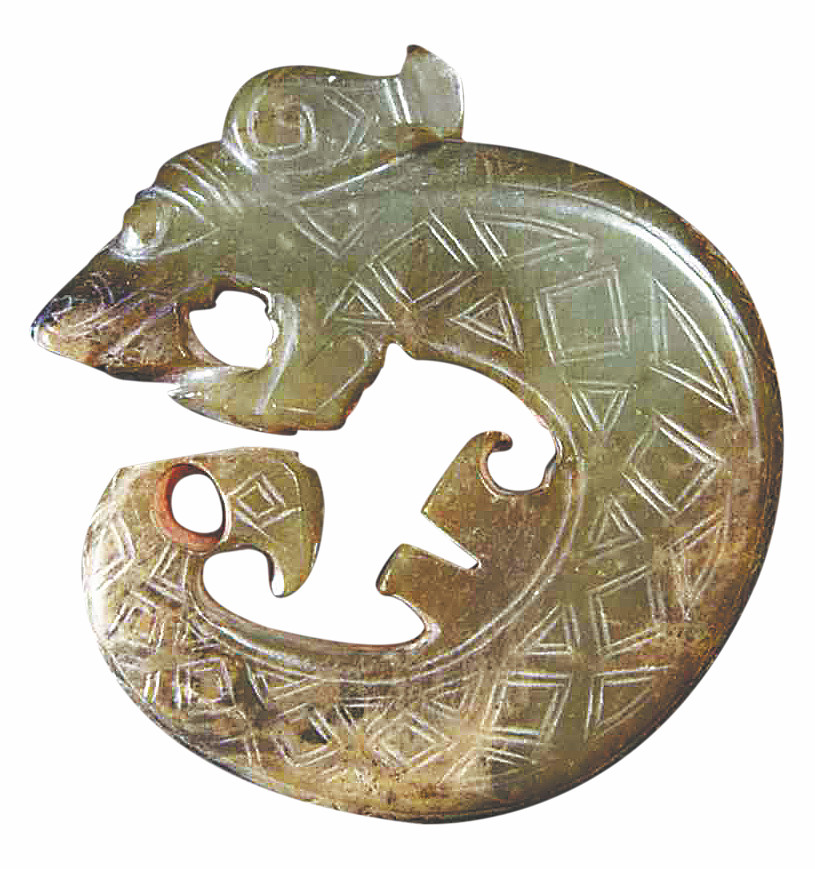
Those who arrived at that conclusion must have examined, very closely, the splendid jade creations of Liangzhu artisans, which testify to the existence of a unified belief system, one of the benchmarks for early statehood. And judging by the tooling marks left on these creations, the use of a string saw seems to have been employed, not diligently, but religiously.
"I am tempted to believe that it was not a mere technical decision. The Liangzhu jade workers, in their single-minded adoption of the string saw, were aiming for something other than handiness and efficiency, something that's deeply spiritual," Tang writes.
The scholar has found support for his view in the 1993 book Technological Choices: Transformation in Material Cultures Since the Neolithic, edited by Pierre Lemonnier, which asserts that in any society, the choices of technology are made on the basis of cultural values and social relations, rather than on the inherent benefits of the technology itself.
"From Xiaonanshan to Liangzhu, symbolism had been accruing where there was once a simple technical solution," says Tang, who's also a professor at Shandong University.
In fact, the Chinese jade story has been steeped in symbolism since day one, says Teng Shu-ping, an ancient Chinese jade scholar from Taiwan. One example she gives is the slit ring. Continually being made in relatively large quantities until the 5th century BC, the slit ring was, according to Teng, connected to a prominent type of ancient Chinese jade known as bi, meaning disc, which she believes was created to reflect the cosmological view of people in prehistoric times, thousands of years before these views were committed to words.
Pointing to the incised concentric grooves that had started to appear on the surface of the discs around 1400 BC, Teng suggests that these lines could be "the sun's different tracks as it moves across the sky over the course of one year".
"The sun's height varies through the seasons. While its course at the summer solstice is represented by the innermost of the concentric circles, its course at the winter solstice, the outermost of the circles," she says. "The center represents the North Celestial Pole, one of the two points — the other being the South Celestial Pole — in the sky where the Earth's axis of rotation, indefinitely extended, intersects the celestial sphere, or the 'canopy heaven' as Chinese would call it."





