A focus on the formative










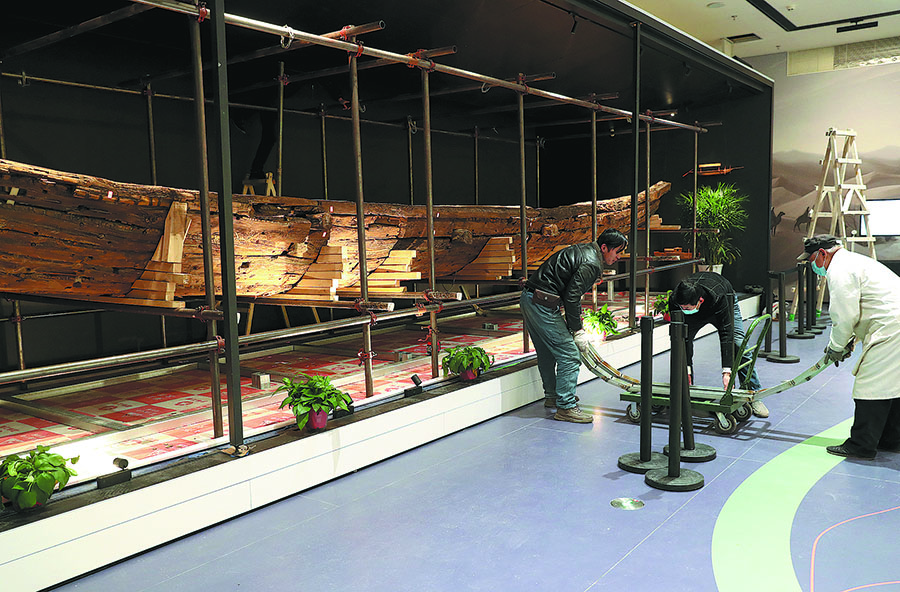
The buildings will be used as exhibition halls, a library, a cultural relic protection center, a restaurant and an activity center, and will become a cultural and tourist complex, she adds.
Many ancient dynasties had their capitals in Shaanxi, in particular the Western Zhou (c. 11th century-771 BC), the Qin, the Han, the Sui (581-618) and the Tang (618-907) dynasties.
"These dynasties exert a very important influence on modern China. The rituals and music system of the Western Zhou Dynasty, the political systems of the Qin and Han dynasties, and Sui and Tang's governing policies with their spirit of openness, inclusiveness and peaceful communication with foreign countries, have all been important influences on Chinese civilization," Ren says.
The ongoing exhibition Great Unity Under Heaven: Civilization of Qin and Han Dynasties displays 732 artifacts that illustrate the contributions of both dynasties to China.
According to Peng Wen, exhibition curator, the show focuses on pioneering systems established during the dynasties, and explores their contributions to China from political, economic, ideological, cultural, technological and communication perspectives through artifacts and multimedia.
"If we say the Greek and Roman civilizations represent Western civilization, then the Qin and Han civilizations are viewed as a representative of Chinese civilization," says Liu Qingzhu, a researcher at the Institute of Archaeology at the Chinese Academy of Social Sciences, who is an expert on Qin and Han archaeology.
"The Qin and Han era was a period of great transformation and development in Chinese society. It was a time when many ancient political systems were devised, and the foundations of Chinese academic and intellectual thought were laid. It was also a time when China began to come together as a unified country of multiple ethnic groups," he adds.
For example, both dynasties standardized written characters, promoted xiaozhuan (small seal script) and then lishu (clerical script), and broke the barriers of communication between different groups of people, thus helping to give rise to civil politics in China, which means scholar officials played a more important role in imperial courts, and often had more power than military officials. This, Liu says, is different from Roman stratocracy, or government by military forces.
"In addition, China has been ruled with the help of written characters since policies and rules were disseminated in written documents, a tradition that continues today. And this custom originated in China under the Qin and Han when words were standardized. This shows consistency and uniformity in Chinese civilization," Liu says.