


Digging to discover the nation's roots










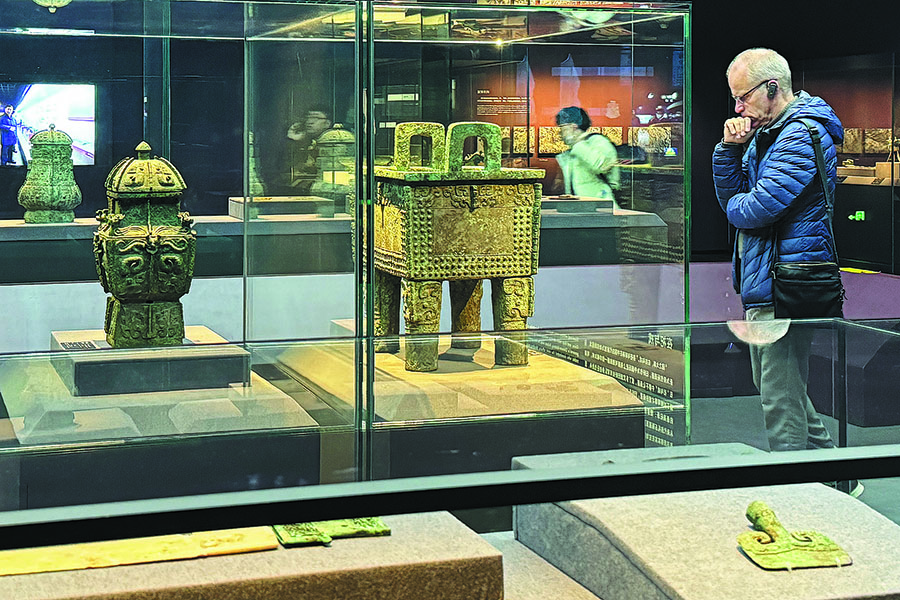
Reporters from domestic and foreign media enjoy a deeper insight into China's origin story through its archaeological findings, Fang Aiqing reports.
Archaeological endeavors to trace the origins of Chinese civilization are helping people learn more about the country's history and culture, and to see how civilization evolved and in what direction it is heading, archaeologist Wang Wei says.
"It's natural that the country's glorious past makes Chinese people proud and confident. Archaeological finds have truly boosted cultural confidence. It's an existing phenomenon, although not the original intention of our work," he says.
The 70-year-old director of the Chinese Academy of Social Sciences' Academic Division of History was answering questions from a group of domestic and foreign media representatives in Beijing on Feb 27 after giving a lecture on the origins and early development of Chinese civilization.
Invited by the State Council Information Office, 33 journalists from 25 foreign media institutions including The Associated Press, The New York Times, Reuters and Bloomberg attended the event, alongside 13 reporters from domestic outlets.
They also had a guided tour of the Chinese Archaeological Museum, which opened to the public in September and is home to more than 6,000 cultural relics from across the country that have been excavated over the past seven decades.
It is based on these relics that the museum has been able to piece together a continuous history from the Paleolithic Age to modern times, says Liu Guoxiang, deputy director of the Chinese Academy of History, which oversees the museum.
The guided tour for the journalists focused mainly on exhibits reflecting social evolution from the Paleolithic and Neolithic periods to the Xia (c. 21st century-16th century BC), Shang (c. 16th century-11th century BC) and Zhou (c. 11th century-256 BC) dynasties.





