Villages vitalized by terraces to heaven
Longsheng's spectacular Longji landscapes usher in environmental and cultural tourism boom, Yang Feiyue reports.










This was a big contrast from the 25,000 yuan they earned in 2003, the 147,000 yuan in 2008, and the 1 million in 2013, says Yu Qiongtong, a senior village committee official in Dazhai.
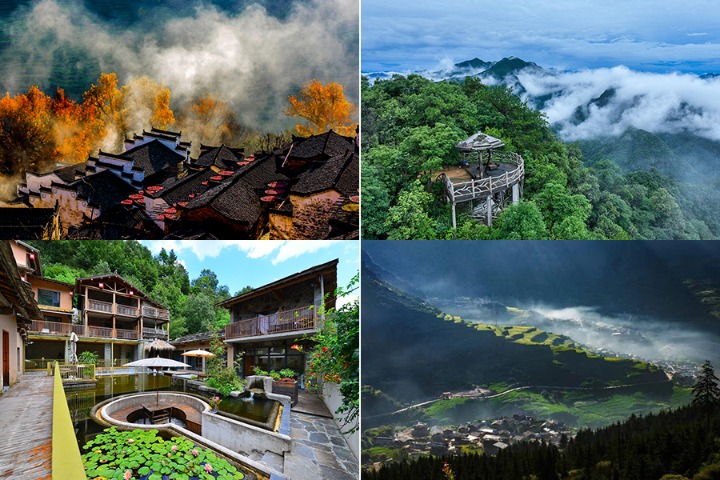
Surrounded by mountains on all sides, there was once only a muddy path leading out of the village. People carried goods on their backs or on mules and lived in stilt houses that were drafty and leaked when it rained. Now, local authorities have managed to turn those basic conditions into attractions.
For example, Dazhai boasts around 66 square kilometers of terraced fields that have been cultivated for around 2,300 years. They follow the terrain of the mountains, at heights ranging from 300 to 1,200 meters above sea level. From swiftly flowing river valleys to mist-covered mountains, dense forests and steep cliffs, wherever there is water and soil, terraces have been dug.
Those in Dazhai are important representatives of Longji terracing, a well-known type of terrace that can be found all over the county.
"The highest tier has more than 1,100 levels, winding from the foot of the mountain to the top, creating a magnificent landscape that resembles a staircase to the clouds," Yu says.
The largest terrace is no more than an acre in size, while the smallest only accommodates a handful of rice seedlings.
Longji terraces are based on an environmental practice that focuses on harmony between humans and nature and the dynamic balance of forests and fields.
It is an important model of ancient Chinese water management and agricultural civilization that has been passed down to the present day, Yu says.
Visitors can appreciate the way the Zhuang and Yao ethnic groups have farmed the terraces and how ancestral farming methods have been preserved.
Every year after the Qingming Festival, villagers begin a series of agricultural activities such as planting and harvesting that have given rise to celebrations.
These festivities have become a rich resource for developing tourism, Yu says.
Lu Chulong, a writer based in Guilin, has been focusing on Longji terraces for two years.
"They are not just beautiful landscapes but also carriers of Zhuang and Yao culture," Lu says.