Bridging the gap between now and then










Work to preserve Pingjiang ensures that it remains a vibrant testament to the city's history, not just a showpiece trapped in its past, Zhao Xu reports in Suzhou.
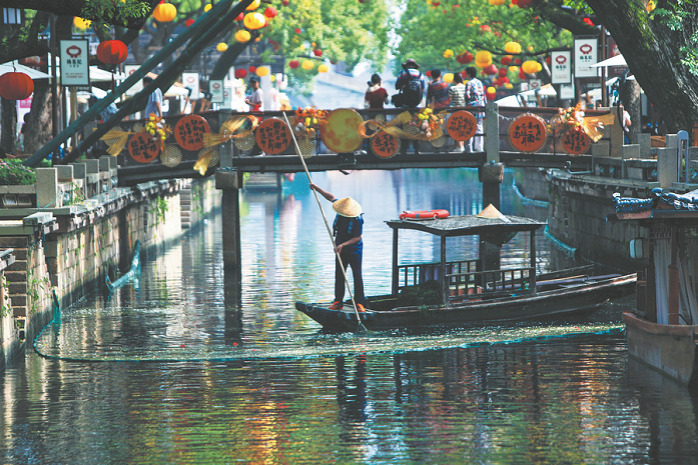
Editor's note: An array of Chinese cities have maintained their cultural memories in the form of historical neighborhoods that have only added to their multilayered charm and vigor with the passage of time. China Daily is taking readers on a journey to some of these timeless areas, where President Xi Jinping has left his footsteps and remarked on the preservation and vitalization of heritage. In this installment, we walk through Suzhou's Pingjiang Historic District, where flagstone roads and flowing water tell a story of Jiangnan, punctuated by ancient, picturesque bridges.
"Upon arriving in Suzhou, you'll see homes nestled by the river's edge. The idle land is as scant as the waterways and bridges are abundant …" Du Xunhe, a poet living in the latter half of the ninth century, during the Tang Dynasty (618-907), wrote in a poem to a friend.
"Canals and bridges — together, they had been visually defining the city for as long as Chinese poetry could remember," says Ruan Yongsan, a lifelong Suzhou resident who has spent the past 55 years of his life trying to protect the land's — and his own — memories.
Occasionally, he will take people on a tour. And the trip will often start at the southernmost point of the Pingjiang River in the northeastern part of the Old Town of Suzhou, which in turn is located in the heart of the city.
There, a small bridge named the Yuanqiao Bridge — yuan means garden and qiao means bridge — is fabled for being where Helyu, king of the vassal state of Wu during the Spring and Autumn Period (770-476 BC), had once lounged, presumably on an amiable spring day. In the fifth century BC, the ambitious ruler built a grand city in modern-day Suzhou, a watery land embedded in the rice-producing Yangtze River Delta region.
A few steps away from the bridge, under a small, pagoda-shaped structure, stands a stone stele with a map inscription bearing the name Pingjiang Tu (The Map of Pingjiang).
"The map was first made in 1229 during the Song Dynasty (960-1279), a time when Suzhou was known as Pingjiang. And the area it covered essentially corresponds with that of our Old Town," says Ruan.