


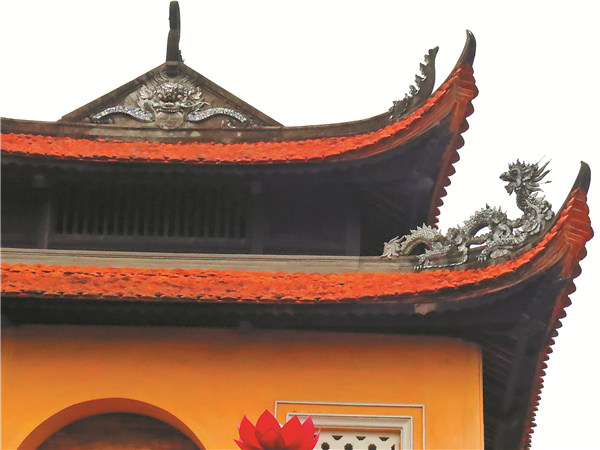
Former imperial site in Vietnam leaves an intriguing opportunity for cross-border cooperation, reports Wang Kaihao in Hanoi.
Describing his last decade's work at the Palace Museum in Beijing, Wu Wei says it was often like "archaeology on the roof".
The researcher, who has worked in the archaeology department of the museum, also known as the Forbidden City, cherishes his time walking along the eaves of the former royal structure.
The Forbidden City functioned as China's imperial palace from 1420 to 1911, during the Ming (1368-1644) and Qing (1644-1911) dynasties, marking the apex of ancient Chinese palatial constructions. This UNESCO World Heritage Site in the heart of Beijing is also the world's largest surviving architectural complex with wooden structures.
From the perspective of archaeology, Wu also has "regrets". Due to limited excavations within the compound of the Palace Museum, it seemed that an imperial city from even earlier than the Yuan Dynasty (1271-1368) was probably buried beneath.
"But the Forbidden City is too perfect," he says, adding that it would be too difficult and damaging to the existing structure to dig.
Sometimes, however, the picture can seem clearer when viewed from afar.
Prototypes of the Forbidden City in Nanjing, Jiangsu province, and Fengyang county in Anhui province were constructed in the early Ming Dynasty before Beijing finally became its national capital, the focus of his studies.
Wu is concentrating on a new turf to get more inspiration. Another "Forbidden City", about 2,400 kilometers to the south of Beijing and beyond the national border, offers an intriguing horizon for his journey exploring the evolution of imperial palaces.
By invitation of the Imperial Citadel Studies of the Vietnam Academy of Social Sciences, Wu has conducted comparative studies since 2023 on the Imperial Citadel of Thang Long in Hanoi. This provided him with a rare chance to join Vietnamese colleagues and have a panoramic view of archaeological materials stretching back almost one millennium.
The citadel was the central seat of Vietnamese imperial power from the 11th century to the 18th century. It was inscribed as a UNESCO World Heritage Site in 2010 on the 1,000th anniversary of its construction.





