


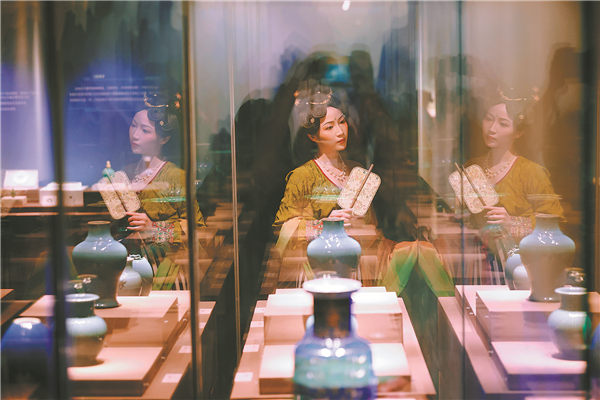
Exquisite ceramics
Ancient poets dedicated numerous stanzas to admire cyan. A rich and descriptive collection of words were used to describe its subtle variations, like canglang (rippling waves), xizi (West Lake beauty), zhuyue (bamboo moon), or qianshancui (verdant mountains), as Zhang Lei notes.
Ceramics probably stand out as a perfect and long-lasting way to fully interpret this exquisite group of colors.
Celadon, most notably produced in Longquan kilns in Zhejiang province dating back more than 1,700 years, showcased its green charm, particularly by the literati.
Changsha wares from Hunan province, during the Tang Dynasty (618-907), were famed for their vivid reflection of natural hues.
The basic tone of celadon was dotted with green adornments. People then often marked paintings and poems on the wares, reflecting a prosperous era of literature.
Blue-and-white porcelain from the Yuan Dynasty (1271-1368), though produced via imported dye, evolved into a signature example of made-in-China products.
In one highlighted exhibit, a Yuan blue-and-white porcelain displays the work of artisans who drew a vivid scene of a famous play.
This scene depicts Xiao He, a statesman from the Han Dynasty, chasing after Han Xin under the moon and persuading this disappointed general to change his mind and come back to serve the Han.
"The decorative patterns of these porcelains show fashion and popular topics during different times," she says.
"Other than admiring their outstanding techniques, we can also feel the warmth of life from these relics."
Longquan products, blue-and-white porcelain and Changsha wares all sailed along the Maritime Silk Road centuries ago, Tan adds.
"From ancient times to the present, the exchange and mutual influence among civilizations have always been the main theme of historical development," he says. "It vividly reflects the inherent 'harmony' in the genes of the Chinese nation."





