


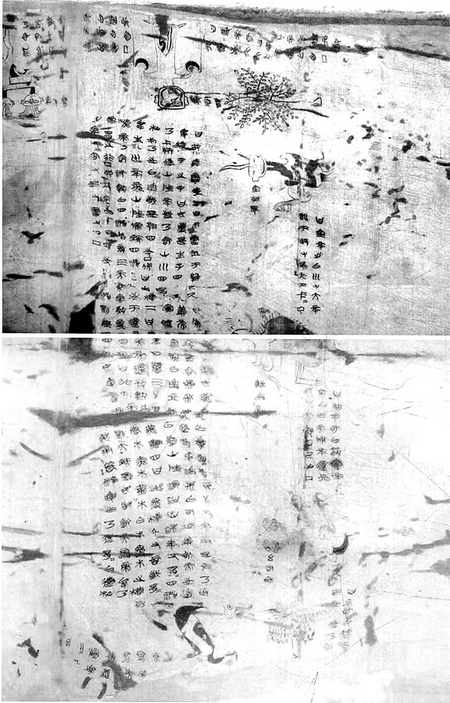
Studies show that the Zidanku manuscripts describe the relationship between humans and heaven with more than 900 Warring States Period characters and pictures of mythical gods. They have three parts — the former two are about traditional Chinese almanacs and the third part is about the application of shushu, or ancient China's occultism in military affairs, Li says.
One of the highlights is the "ordinances of the five agents", an ancient way of dividing a year into 30 solar terms and five parts, each lasting 72 days based on wuxing, or five agents, the five elements in ancient Chinese philosophy. This is different from the systems now followed dividing a year into four seasons, 12 months and 24 solar terms.
"Zidanku manuscripts are important not only as the earliest silk manuscripts in China written with Warring States Period characters but because they reflect the outlook on the universe, philosophy and religion of ancient China," Li says.
He says Zidanku manuscripts are just like China's version of the Dead Sea Scrolls, one of the oldest surviving manuscripts of the Hebrew Bible. "The scrolls, dating back to 200-100 BC, were unearthed five years later than Zidanku manuscripts, which date back to 300 BC. Just as the Dead Sea Scrolls are important for the study of Western and Christian culture, the Zidanku manuscripts open a door for us to glimpse into the ancient Chinese world of occultism," says Li.
He says people often have the impression that ancient Chinese people highlighted liberal arts more than technologies, but it has been found not true. For example, in Yiwenzhi, a section of the Book of Han authored by historian Ban Gu (32-92), more than half of the content is about the art of war, shushu and technology.
"Ancient Chinese cared a lot about natural law, the universe, the human body, medicine and military affairs. These things occupy half of ancient China's academic studies," says Li. "This half is often ignored, but unearthed discoveries like the manuscripts help us open the door to this world."
Li has traced every part of the manuscripts' journey from China to the US and published his famous collection Zidanku Silk Manuscripts in 2017, elaborating on his investigation of how the artifacts were unearthed, transported to the US and their circulation.





