


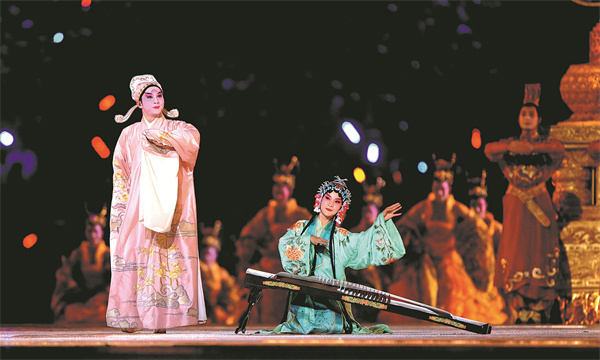
"My interest in French music started with Debussy. In his works, I could feel that the composer tried to use the piano to portray the landscape of the East. He possibly encountered some challenges since the piano may not fully display his musical ideas. But for the guzheng, an ancient Chinese musical instrument, it may be able to achieve what the composer tried to express," says Chang, who envisioned how the French composer wrote the music pieces, as she says, "like traveling back to Debussy's days and having a talk with him".
Chang stays loyal to Debussy's scores as well as integrating her own ideas.
"There are some music notes on his scores which cannot be produced by the guzheng, so I made some changes, taking some notes out as well as adding notes that I believed to be harmonious to fit the scores," Chang adds.
She chose to adapt Ravel's two music works Bolero and Pavane Pour une Infante Defunte (Pavane for a Dead Princess), which are well-known worldwide.
"The relentless snare drum underpins the whole of the 15-minute piece as Ravel inexorably builds on the simple tune until the last part when he finally releases the tension with a burst of rhythms like fireworks," says Chang, talking about Bolero.
"I couldn't make the orchestral sound with the guzheng, but what I could do was to leave some space for the listeners to imagine," says Chang. "It's just like traditional Chinese ink painting, which has a technique called liubai, or leaving blank space. The core spirit of the technique is to use less to achieve more."
As for Satie, Chang adapted three music pieces from two of the French composer's works: Trois Gnossiennes and Trois Gymnopedies.
Unlike Ravel and Debussy's works, which Chang recorded in a professional recording room in Beijing — with 14 microphones surrounding her "like a universe" — Chang recorded music works by Satie at her room when she stayed in Bangkok, Thailand.





