


A player of many ages









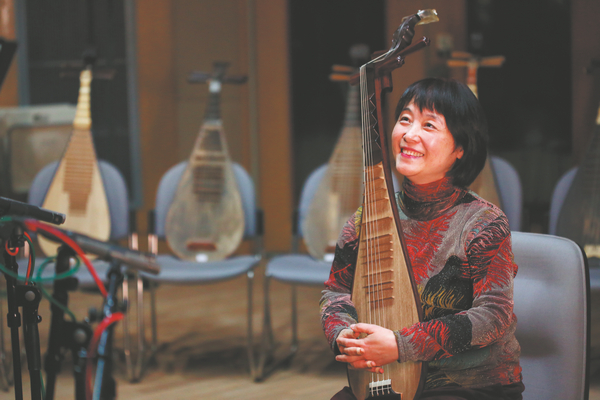
"For the young musicians, it was not just about rehearsals and concerts but also about a thrilling adventure into the heart of musical exploration," she continues, adding that the musicians reminded her of her own days as a student learning to play the pipa at Beijing's Central Conservatory of Music. A child prodigy who began learning at 9, Wu was accepted into the conservatory at 13 and became the first recipient of a master's degree in pipa in the country.
Talking about the Pipa Concerto No 2, a warm, rhapsodic piece Zhao wrote expressly for her, Wu says the 22-minute movement integrates elements of pingtan, a type of folk art from Suzhou in Jiangsu province, which combines storytelling and ballads in the Suzhou dialect. Performers are usually accompanied by traditional stringed instruments, such as the sanxian (a three-stringed lute) and the pipa, as well as woodwind instruments.
The concerto premiered at the Sydney Opera House where it was performed by the Sydney Symphony Orchestra with Wu as soloist. Since then, she has performed it many times around the world.
"The concerto has become one of the most performed pieces in my repertoire. Whenever I play it, it conjures up images of my hometown, its rivers, pavilions, teahouses and even its dialect," says Wu, who was born and raised in Hangzhou, Zhejiang province.
The pipa, which has its roots in Central Asia, has been in existence for over 2,000 years. Known for its distinctive pear-shaped body, it typically has four strings and is played either with the fingers or a plectrum. It is known for its versatility and expressive range and is capable of producing both melodious and percussive sounds, playing a significant role in Chinese musical heritage.
The celebrated player, who currently lives in California, is considered the ambassador for the pipa and has brought the instrument international acclaim.
Her performances and recordings have helped introduce the pipa to global audiences by blending classical Chinese music with contemporary styles. Her latest album Seeking the Tao of Strings was released in June by Longyuan Music.
Aside from her experiments with contemporary rock and jazz musicians, Wu is a traditionalist and plays 11 pipa instruments from the late 19th century to early 20th century.